
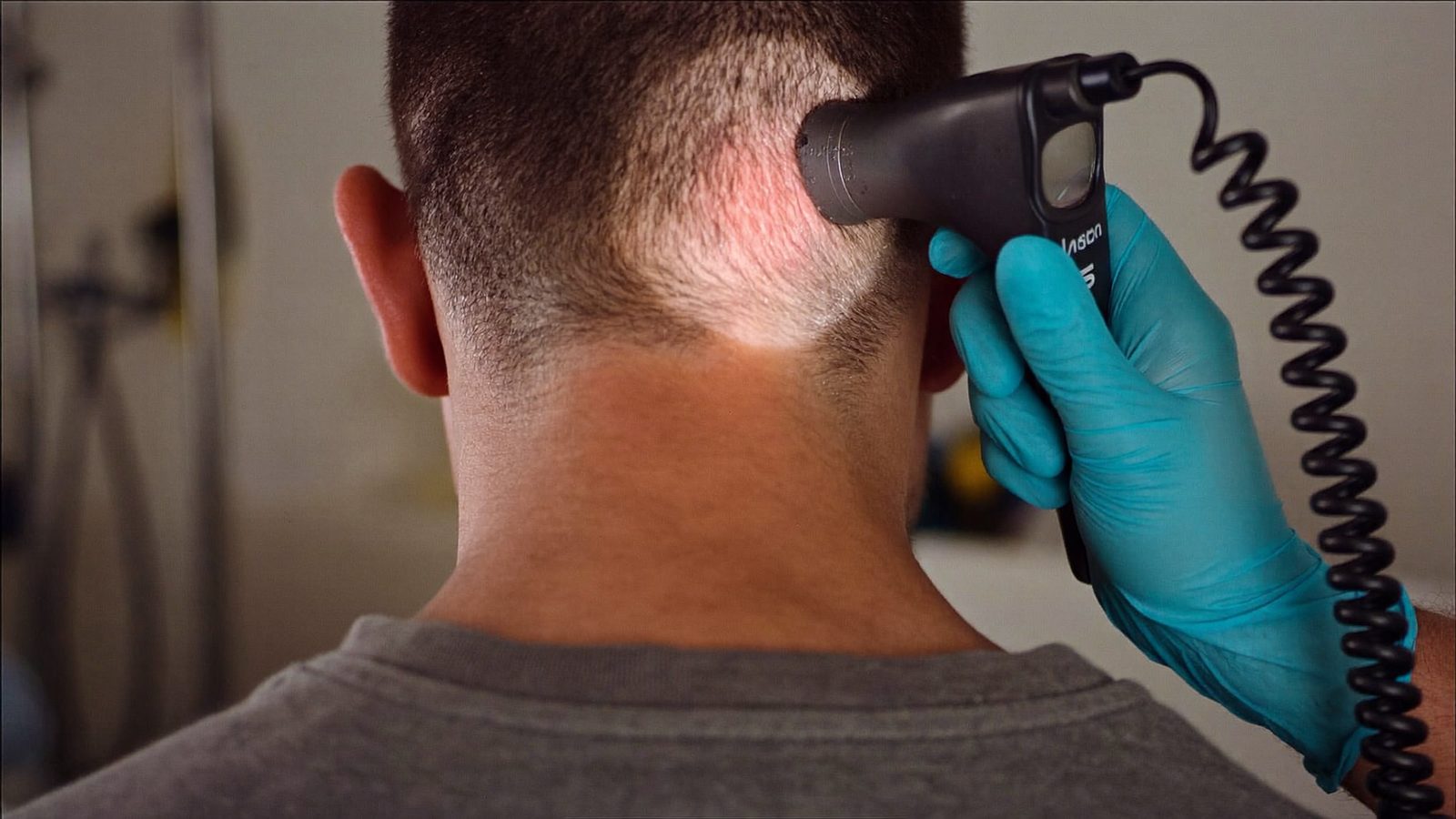
The hair transplant donor area is the band of permanent hair at the back and sides of your scalp, and it is the only source of grafts for a scalp transplant. It is finite: most people can safely give a few thousand grafts over a lifetime, and how that supply is measured, spent and protected shapes every result. If you are weighing FUE hair transplant surgery on Long Island, the donor area is the first thing we examine, because it sets the ceiling on what any plan can achieve.
This guide explains where the safe donor zone sits, why that hair resists balding, how density is measured at a consultation, what overharvesting looks like when it goes wrong, and which backup sources exist when the scalp alone is not enough. It is written from the planning side of the table: the questions our Long Island team asks before a single graft is counted.
Quick Answer: Your Donor Area Is a Lifetime Budget
Your donor area is a fixed account of permanent follicles, and most people can safely withdraw a few thousand grafts from it over a lifetime, often estimated at roughly 5,000 to 7,000 grafts depending on density. Nothing regrows in the spots where follicles have been removed. Every graft placed in the hairline or crown is a graft that will never be available again.
That single fact changes how a sensible plan is built. A transplant is not a matter of moving as much hair as possible in one day. It is a matter of deciding what the supply should be spent on now, what should be held in reserve for future thinning, and how to take grafts without leaving the back of the head looking sparse. Two people with the same bald patch can need very different plans because one has a dense, wide donor band and the other has a narrow, fine one.
Key point: A transplant does not create new hair. It redistributes a limited supply. The quality of your donor area, not the size of your bald spot, is usually what decides how far a plan can go.
When patients ask us whether they can "fix everything" in one session, the honest answer starts with the donor area. If the supply is generous and the hair loss is moderate, a full-looking result is often realistic. If the supply is modest and the loss is extensive, the plan has to prioritize the zones that frame the face and accept lighter coverage elsewhere. For the separate question of how a graft number is worked out zone by zone, see our guide on estimating the graft count your plan needs.
Where the Safe Donor Zone Is and Why It Resists Balding
The safe donor zone is a horseshoe-shaped band running from just above one ear, around the back of the head, to just above the other ear, and its follicles are genetically less sensitive to the hormone that drives pattern baldness. That resistance is the whole reason a hair transplant works.
DHT sensitivity and donor dominance
Male pattern hair loss is driven largely by dihydrotestosterone (DHT). Follicles on the top of the scalp, the temples and the crown tend to be sensitive to it and shrink over time. Follicles in the lower back and sides of the head are usually far less sensitive. When those resistant follicles are moved to the top of the head, they keep behaving the way they did in their original location. Hair restoration specialists call this donor dominance, and it is why transplanted hair in a well-chosen zone is expected to last.
Why the edges of the zone matter
The safe zone is not a sharp line. Its upper border can drift downward as pattern loss progresses, and its lower edge near the nape often holds hair that is finer or less stable. Taking grafts from too high on the head risks harvesting follicles that may later thin, which means transplanted hair that eventually fades in its new home. Taking them from too low can leave visible marks where the hair is naturally sparse. Good planning stays inside the middle of the band, where the hair is most reliable.
Age adds a complication. Someone in their twenties has not yet shown how far their hair loss will go, so the boundary of the safe zone is a prediction rather than a fact. That is one reason we are cautious with younger patients and keep a larger reserve in their plans. The Norwood scale helps here: someone who is heading toward a Norwood 6 or 7 pattern will have a narrower final donor band than someone who stabilizes at a Norwood 3.
Women and diffuse thinning
Female pattern loss, usually graded on the Ludwig scale, tends to be diffuse rather than patterned. Some women also have thinning in the back and sides, which weakens the donor area itself. For that reason a donor assessment is especially important before any female hair transplant is considered. If the donor hair is affected by the same process as the thinning areas, a transplant may not be the right tool.
How Donor Density Is Measured at a Consultation
Donor density is measured by looking at the scalp under magnification and counting how many follicular units and hairs grow in a known area, then combining that count with hair caliber, scalp laxity and the width of the safe zone. A quick glance in a mirror cannot tell you this, which is why we do not quote a plan without examining the back of the head.
What we look at
- Follicular unit density: how many natural groupings of hair exit the skin per square centimeter. More units means more grafts available without visible thinning.
- Hairs per unit: follicular units carry one to four hairs. A donor area rich in two and three hair units gives more coverage per graft.
- Caliber: thick, coarse hair covers more scalp than fine hair. Two donors with the same count can look very different once transplanted.
- Miniaturization: if some donor hairs are already thinning, the zone may be less stable than it looks.
- Zone size: the height and width of the usable band, which varies with head shape and the extent of hair loss.
- Scalp laxity: how loose the skin is, which matters mainly if strip harvesting is being considered.
- Hair and skin contrast: dark hair on pale skin shows thinning more easily than hair that is close to skin tone.
Densitometry and the trichoscope
A handheld densitometer or a digital trichoscope magnifies a small window of scalp so the clinician can count units and spot miniaturized hairs. We check several points across the donor band rather than one spot, because density often varies from the midline to the areas above the ears. The readings feed into a donor estimate that Dr. Prokurat reviews before any plan is finalized.
The output is not a single number on a lab report. It is a judgment that combines measured density with how your loss is likely to progress, your age, and how short you plan to wear the back and sides. Someone who keeps a number two clipper cut needs a more conservative harvest pattern than someone who wears the back longer, because short hair hides less.
What you can do before the visit
Let the back of your hair grow for a week or two if you normally keep it very short, so the units are easy to count. Bring photos of how your hair looked a few years ago and a list of any medications. If relatives on either side of your family have extensive baldness, mention it, because it helps predict where the edge of the safe zone will end up.
What Happens to the Donor Area After FUE
After FUE, the donor area keeps most of its hair, but each extracted follicle leaves a tiny round scar and no new hair grows from that exact spot. When extraction is spread evenly and kept within safe limits, the remaining hair covers those dots and the area looks normal at most lengths.
In the first days, the donor area shows small red points where grafts were taken. These crust and fade over roughly one to two weeks. The hair around them can be trimmed short for the procedure, so the back of the head looks evenly buzzed at first and then grows out. By the time the hair is a few weeks long, most people find the donor area unremarkable.
The key phrase is "spread evenly." Our in-house technicians use manual FUE with motorized handheld tools, and extraction is planned so that neighboring units are left in place and the harvest is distributed across the whole safe band rather than concentrated in one patch. That spacing, along with chilled graft storage and physician-reviewed plans, is part of the Nova Medical FUE Protocol we follow for every case.
FUT treats the donor area differently. It removes a narrow strip from the middle of the safe zone and closes the edges, leaving a single fine linear scar while the surrounding density stays untouched. Some patients with large lifetime needs combine the two methods over time to make the most of the supply. For a full comparison of the two harvesting methods, read our guide to choosing between FUE and FUT.
Overharvesting: What It Looks Like and How It Is Avoided
Overharvesting is what happens when too many follicles are taken from the donor area, or too many from one spot, leaving the back of the head visibly thin, patchy or moth-eaten. It is permanent, because the removed follicles do not return, and it is one of the most common problems we see in patients who come to us after surgery elsewhere.
The signs
- A see-through look at the back of the head, especially under bright light or when the hair is wet.
- Patches or tracks where extraction was concentrated, often in a rough grid or band.
- Clusters of white dot scars that remain visible even with the hair grown out to medium length.
- Thinning above the ears or at the upper edge of the zone, where harvesting strayed outside the stable band.
- Transplanted hair that later thins because it came from follicles that were never truly permanent.
Why it happens
The most common cause is a plan built around the size of the bald area instead of the size of the donor supply. If a clinic agrees to cover an advanced Norwood pattern at high density in one day, the grafts have to come from somewhere, and that usually means extraction that is too dense or too wide. Large "mega session" promises and offers of unlimited grafts deserve careful questions for exactly this reason. No donor area is unlimited.
Poor technique adds to the problem. Extraction that clusters in easy-to-reach areas, punches that transect follicles so more must be taken to reach a target, and harvesting from outside the safe zone all reduce the usable supply faster than necessary. Pricing models can play a part too. When cost is tied to graft volume, there can be pressure to move more grafts than a donor area should give, which is one of the issues covered in our article on what drives the price differences between clinics.
How we avoid it
Prevention starts at the consultation. We set a per-session extraction limit based on measured density, not on the number the patient hopes to hear. We spread extraction across the full width of the safe band, leave adequate spacing between harvested units, and keep a reserve for the future. If the donor supply cannot support the coverage someone wants, we say so and suggest a plan that concentrates on the front of the scalp, where the visual impact is greatest.
Key point: Ask any clinic how many grafts it estimates your donor area can give over a lifetime, how much of that the proposed session uses, and how extraction will be spread. A clear answer to all three is a good sign.
If overharvesting has already happened
A depleted donor area can sometimes be improved. Options include camouflaging dot scars, carefully harvesting from areas that were left untouched, using beard or body hair to soften patchiness, or scalp micropigmentation to reduce contrast. Our hair transplant repair service is built for these cases, and the first step is always a careful map of what supply is left.
Donor Quality vs. Realistic Plan
The quality of your donor area determines what kind of plan is realistic, and the table below shows how we typically think about that relationship. It is a planning guide, not a promise; your own assessment can shift any row.
| Donor profile | What we usually measure | Realistic approach | Main caution |
| Strong | High unit density, many two and three hair units, coarse caliber, wide safe band, little miniaturization | Fuller coverage of the front and mid scalp, crown work possible, healthy reserve left for later | Still finite; resist spending the reserve on low-impact areas early |
| Average | Moderate density, mixed unit sizes, medium caliber, standard safe band | Prioritize hairline and frontal third; crown later or lighter if loss progresses | Plan around likely future loss rather than today's pattern alone |
| Fine or low contrast | Moderate density but fine hair, or hair close to skin tone | Same priorities; layered placement to build visual density in key zones | Fine hair covers less, so expectations for density need care |
| Limited | Low unit density, narrow safe band, or visible miniaturization in the donor area | Small, targeted sessions on the hairline; consider beard or body hair to supplement | High risk of visible thinning if extraction is pushed |
| Unstable or affected by other loss | Diffuse thinning in the back and sides, possible scarring or other hair conditions | Often not a transplant candidate at this time; medical management first | Grafts from unstable donor hair may not last |
| Previously overharvested | Patchy density, clustered scars, reduced remaining supply | Repair-focused plan, careful mapping, secondary sources, camouflage | Every remaining graft must be weighed carefully |
Notice that the right column rarely says "more grafts." Even with a strong donor area, the realistic plan includes a reserve. With a limited one, the plan gets smaller and more focused rather than stretched thin across the whole scalp. That is the trade-off behind a limited donor hair transplant: you accept less coverage in exchange for a donor area that still looks natural.
Beard and Body Hair as Secondary Donor Sources
Beard hair and, less often, chest or other body hair can be used as secondary donor sources when the scalp supply is limited, but they behave differently from scalp hair and are usually supplements rather than replacements. They are most useful for adding density in the middle or crown of a plan, not for building a soft, natural hairline.
Beard hair
Beard hair is the most useful backup for many men. The hair under the chin and along the neck is often thick, coarse and resistant to pattern loss, so it can add bulk where coverage is needed. It also tends to be curlier and wirier than scalp hair, and it grows in single hair units more often, so it is generally reserved for zones behind the hairline where texture differences are less noticeable. Taking grafts from the beard leaves tiny marks that are usually hidden once the beard grows back, but men who keep a fully shaved face should discuss this carefully.
Body hair
Chest, abdomen and other body hair can be harvested in selected cases. These hairs often have a shorter growth cycle, so they may not grow as long as scalp hair, and yield can be less predictable. We view body hair as a specialist option for patients with severely limited scalp donor supply or repair needs, not as a routine source.
Moving hair the other way
The same donor area that feeds the scalp can also supply grafts for the face. A beard transplant or eyebrow restoration uses scalp donor hair too, so anyone planning both a scalp and a facial procedure needs one combined budget rather than two separate ones. We map that out at the start so neither procedure quietly uses up the other's supply.
Protecting Your Donor Supply Over the Long Term
The most reliable way to protect your donor supply is to slow the hair loss that would otherwise demand more grafts in the future. Every year that your native hair holds steady is a year you do not need to spend donor reserves chasing it.
Medical therapy has a large role here. The FDA has approved finasteride and minoxidil for pattern hair loss, and many patients use them to stabilize native hair around a transplant. They do not replace surgery, and they are not right for everyone, so talk to your physician about whether either is appropriate for you. PRP is another option some patients use alongside a transplant; it is offered at our Melville clinic and discussed at the assessment where relevant.
Timing protects the supply as well. A first session that focuses on the front gives the biggest visual return for the grafts used. If loss later spreads to the crown, there is still donor hair available to address it. Plans that begin by covering the crown in a young patient can leave too little for the hairline if loss accelerates. For a wider look at how results hold up over decades, read our article on what lasts after a hair transplant and what can still change.
Finally, choose a team that will tell you no. A clinic willing to say "this area should wait" or "your donor area cannot support that" is protecting the one resource you cannot replace. The ISHRS encourages patients to ask about donor management at consultation, and the American Academy of Dermatology notes that hair loss has many causes, which is one reason a proper diagnosis comes before any surgical plan.
Getting Your Donor Area Assessed in Melville
A donor area assessment takes place at our clinic at 445 Broadhollow Rd on Route 110 in Melville, a short drive from the Long Island Expressway for patients across Nassau and Suffolk counties. The assessment is free and there is no obligation to book a procedure.
During the visit, a member of our team examines your donor zone under magnification at several points, records density and caliber, photographs your pattern and talks through your goals. Dr. Prokurat reviews the findings and the proposed plan, including a lifetime donor estimate and how much of it the first session would use. You leave with a clear picture of what is realistic and a written quote based on graft count, with no session fees and 0% financing for the first 12 months available.
Appointments run Monday to Friday, 9am to 6pm. You can call (516) 202-7223 or use the form on this page to choose a time.
Spending Your Donor Supply Wisely
The donor area is the quiet half of every hair transplant. Patients naturally focus on the hairline they want, but the back of the head decides how far that hairline can go, how long it will hold, and whether a second session is possible years from now. Measuring density carefully, staying inside the safe zone, spreading extraction evenly and keeping a reserve are what separate a result that ages well from one that leaves two problems instead of one.
If you remember one idea from this guide, make it this: treat your donor hair as a lifetime budget, and judge any plan by how carefully it spends that budget. A free assessment with our Long Island team will tell you how large your budget is and how we would suggest using it.
Medically reviewed by Dr. Val Prokurat, MD. Dr. Prokurat is a physician with advanced training in minimally invasive techniques who reviews and oversees every treatment plan at Nova Medical Hair Transplant Long Island, 445 Broadhollow Rd in Melville. This article is for general education and is not a substitute for an in-person medical assessment. Individual results vary. Read more about Dr. Prokurat.
Get Your Donor Area Measured
At a free assessment in Melville we measure your donor density under magnification, estimate your lifetime supply and show you a plan that spends it carefully.