
How many grafts do I need? For most people, a first session lands somewhere between 1,500 and 3,000 grafts, but your own number depends on three things: how large the thinning area is, how dense you want the result to look, and how many grafts your donor area can safely give over a lifetime. Because clinics price by the graft, that count is also the main driver of what you will pay, and our hair transplant cost guide for Long Island explains how the per-graft rate turns into a written quote.
This article walks through the numbers the way we do in a consultation room in Melville. We break the scalp into zones, show typical graft ranges for each Norwood stage, explain the density targets that make hair read as full rather than see-through, and show how to split a limited supply between the front and the crown. By the end you should be able to estimate your own range before you ever pick up the phone.
Quick Answer: Most First Sessions Use 1,500 to 3,000 Grafts
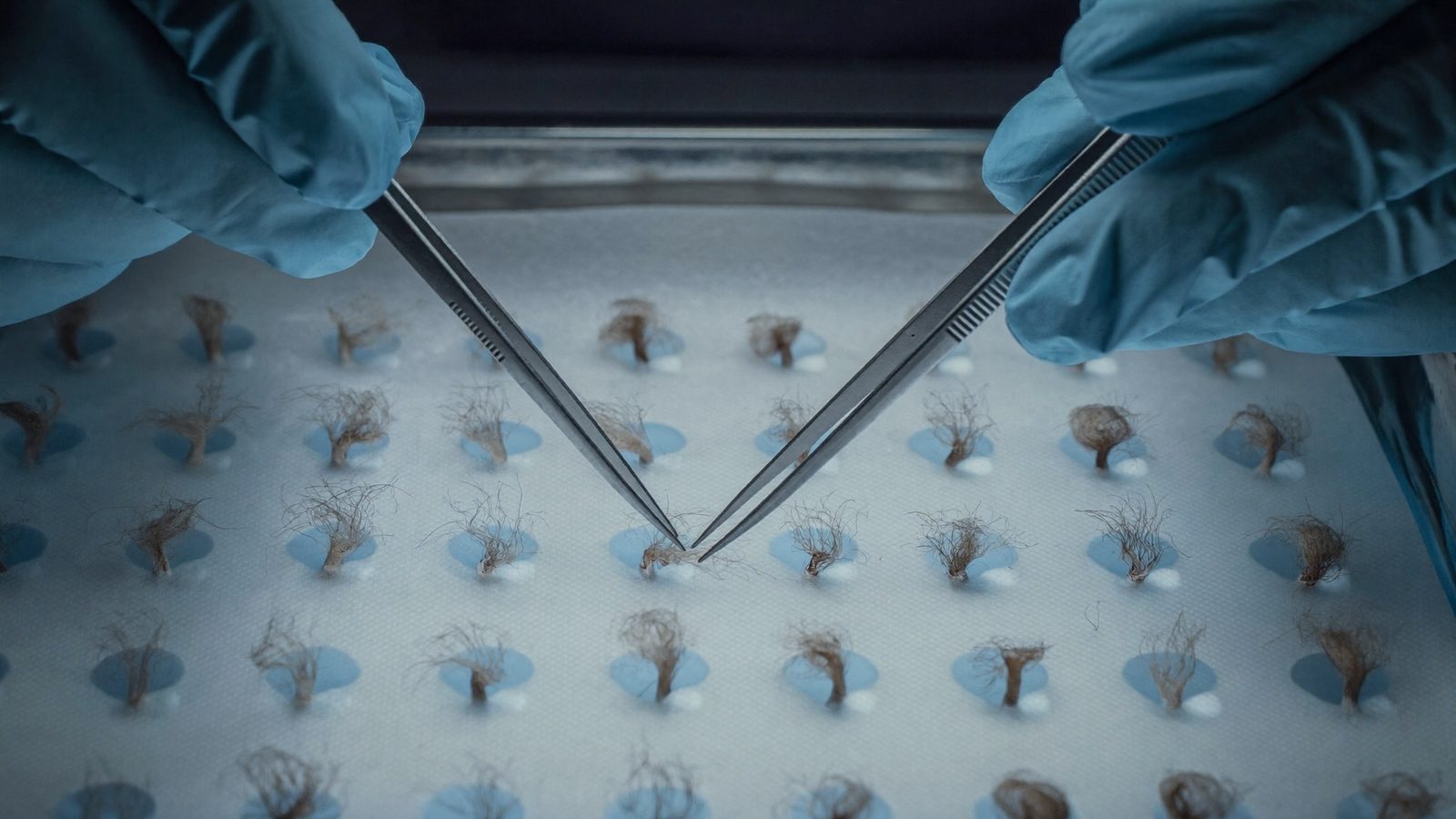
A typical first procedure uses 1,500 to 3,000 grafts, with smaller hairline refinements as low as 800 to 1,200 and large frontal-to-crown cases reaching 3,500 or more. A graft is a follicular unit, the natural cluster of one to four hairs that grows from a single opening in the skin. So 2,000 grafts usually means somewhere around 4,000 to 5,000 individual hairs, because the average graft carries a little more than two hairs.
Three variables move you up or down that range:
- Surface area. A temple recession covers a few square centimeters. A bald crown on a Norwood 6 can cover well over 100. Area is the single biggest factor in the count.
- Target density. A soft, natural transition needs fewer grafts per square centimeter than a dense, crisp frontal block. Both can look good; they cost different amounts of donor hair.
- Donor supply and hair character. Thick, coarse or wavy hair covers more scalp per graft than fine, straight hair. A dense donor area with many three- and four-hair units stretches further than a sparse one.
Key point: A graft count is not a score where higher is better. The right number is the smallest one that achieves the look you want in the zones that matter to you, while leaving enough donor hair for the future.
Graft Ranges by Zone: Hairline, Frontal Third, Mid-Scalp and Crown
Each part of the scalp has its own typical graft range, and the hairline zone almost always gets the highest density per square centimeter. Surgeons and technicians plan in zones because each one plays a different visual role. The front frames your face. The mid-scalp provides volume when you look down at a mirror. The crown is seen mostly from behind and above, by other people rather than by you.
Here is how we usually think about each zone:
Hairline and temples
The front edge of hair, the first 1 to 2 centimeters, is built almost entirely from single-hair grafts placed at a low angle and in an irregular pattern. Closing mild temple recession may need 400 to 800 grafts. Rebuilding a full new hairline on someone who has lost it entirely can take 800 to 1,200 grafts on its own, before any density is added behind it.
Frontal third
Behind the hairline sits the frontal third, roughly from the hairline back to an imaginary line across the top of the ears. This is where two- and three-hair grafts give the impression of thickness. For a Norwood 3 to 4 pattern, the frontal third, including the hairline, commonly uses 1,500 to 2,500 grafts.
Mid-scalp
The mid-scalp bridges the front and the crown. When it is thinning but not bald, a few hundred grafts can restore the look of a continuous top. When it is fully bald, 800 to 1,500 grafts is a normal allocation, often split across two procedures.
Crown (vertex)
The crown is the hungriest zone. Hair there grows in a swirl, so it fans out in many directions and creates more visible gaps at the same density. A small thinning crown may need 600 to 1,000 grafts. A fully bald crown can absorb 1,500 to 2,500 grafts and still look lighter than the front. The crown can also keep expanding with age, which is a major reason we are cautious about it in younger patients.
A quick self-estimate that many people find useful is the fist rule. Make a loose fist and place it on the bald or thinning area. A fist covers very roughly 25 to 35 square centimeters, depending on hand size. At 35 to 45 grafts per square centimeter, each fist-sized area therefore takes somewhere around 900 to 1,500 grafts to look naturally full. Two fists across the front and top suggests a first session at the upper end of the usual range. It is rough, but it puts you in the right ballpark before a proper measurement.
Norwood Stage vs. Typical Graft Range and Number of Sessions
Your Norwood stage gives a reliable first estimate: the higher the stage, the more grafts and the more likely it is that the plan runs over two sessions. The Norwood scale classifies male pattern hair loss from stage 1 (no recession) to stage 7 (only a horseshoe of hair at the sides and back). Women are classified on the Ludwig scale, which describes diffuse thinning over the top rather than a receding line, and their graft planning follows different rules. The ranges below are typical for men with average donor density and hair caliber.
| Norwood stage | What it looks like | Typical graft range | Usual number of sessions |
| Norwood 2 | Mild temple recession, hairline slightly higher | 500 to 1,000 | 1 (often not needed yet) |
| Norwood 3 | Deeper temple recession, clear M-shape | 1,200 to 2,000 | 1 |
| Norwood 3 vertex | Temple recession plus early crown thinning | 1,500 to 2,500 | 1, crown sometimes deferred |
| Norwood 4 | Front receded, crown thinning, band of hair between | 2,000 to 3,000 | 1 to 2 |
| Norwood 5 | Band between front and crown narrowing | 3,000 to 4,500 | 2 |
| Norwood 6 | Front and crown joined into one bald area | 4,000 to 6,000 | 2 to 3 |
| Norwood 7 | Only a narrow horseshoe remains | 5,000 to 6,000 or more | 2 to 3, coverage prioritized over density |
Two cautions apply to this table. First, these are totals across a whole plan, not single-day numbers for the higher stages. Second, at Norwood 6 and 7 the total need on paper can exceed what any donor area can supply, since a lifetime supply is usually somewhere around 5,000 to 7,000 grafts depending on density. That does not make a transplant pointless, but it changes the goal from full density everywhere to smart coverage where it counts. For a stage-by-stage look at options beyond surgery, our guide to planning male hair restoration at each stage goes into medication, timing and when to wait.
Density Targets: Why 40 to 50 Grafts per Square Centimeter Usually Looks Full
For most people, 40 to 50 grafts per square centimeter in the front reads as full hair at normal viewing distance, even though natural untouched scalp often holds 70 to 100 follicular units per square centimeter. That gap surprises people. The explanation is that the eye does not count follicles. It notices whether light passes through to the scalp. Once roughly half of the original density is present, most hair hides the skin beneath it under normal lighting.
The useful density depends on where the grafts go and what kind of hair you have:
- Hairline zone: 35 to 50 grafts per square centimeter, mostly single hairs, with a feathered irregular edge so it does not look like a wall.
- Frontal third behind the line: 40 to 50 grafts per square centimeter, using multi-hair grafts for body.
- Mid-scalp: 30 to 40 grafts per square centimeter is often enough, because the front hair falls back over it.
- Crown: 25 to 40 grafts per square centimeter on a first pass, with an optional second pass later if you want more.
Hair characteristics change the math. Coarse hair, wavy or curly hair, and low contrast between hair and skin color (for example light hair on fair skin, or dark hair on darker skin) all create more visual coverage per graft. Fine, straight, dark hair on pale skin is the hardest combination, because every gap shows. Two people with identical bald areas can therefore need noticeably different counts to reach the same look.
There is also a ceiling. Packing grafts too tightly in one sitting can compromise blood supply to the newly placed follicles and reduce how many survive. The ISHRS has long emphasized that planning and graft handling matter as much as raw numbers, and that matches what we see: a carefully spaced 45 per square centimeter tends to beat an aggressive 70 that the tissue cannot support. If you want to know how harvesting method interacts with these density targets, our comparison of the two main harvesting techniques covers how many grafts each one can typically yield in a day.
Key point: Full-looking hair is about hiding the scalp, not replacing every follicle. Aiming for roughly half of natural density in the zones that frame your face is how a finite donor supply produces a result that looks complete.
Allocating Grafts: Why the Front Comes First and the Crown Can Wait
When grafts are limited, we almost always put the front first because the hairline and frontal third shape how your face looks to everyone, including you, every day. This is the heart of graft allocation, and it is where poor planning causes the most regret. A donor area is a fixed budget. Every graft spent on one zone is a graft that is no longer available for another.
Think about the visual payoff of each zone. A restored front changes your reflection, your photos and how old you look. A partly restored crown is seen mainly from behind, and many people with a solid front and a lighter crown feel satisfied. The reverse, a dense crown with a receding front, rarely looks natural and is hard to correct later.
Here is how allocation decisions typically play out in practice:
- Secure the frame. Rebuild the hairline at a mature, age-appropriate height and fill the frontal third. This often uses half or more of a first session.
- Add mid-scalp support. Extend coverage back so the front has something to fall onto and there is no visible gap when you part or style your hair.
- Treat the crown with what is left, or plan it for later. If your donor area is strong and your loss looks stable, the crown can be addressed in the same or a second session. If not, medication and a wait-and-see approach often make more sense.
Age matters too. Someone in their mid-twenties with an early crown may lose more hair around and behind it over the next decade. Grafting that crown now can leave an island of transplanted hair in a growing bald area. Holding grafts in reserve protects the option to treat the front again if the pattern progresses. The American Academy of Dermatology notes that pattern hair loss is progressive, which is why we discuss FDA-approved finasteride and minoxidil with many younger patients. Whether either medication suits you is something to talk to your physician about.
A hairline placed too low also wastes grafts and looks out of place in later decades. A slightly higher, softly irregular line uses fewer grafts per centimeter of width, looks right at 30 and at 60, and leaves more of the budget for density behind it.
Common Planning Mistakes That Waste Grafts
The most common planning mistake is spreading grafts too thinly over too large an area, which leaves every zone looking sparse instead of making one zone look finished. People sometimes ask for the whole top of the head to be covered in one go, but 2,500 grafts spread over 150 square centimeters is under 17 per square centimeter, which most people would not call full.
Other patterns we see when people bring in plans or results from elsewhere for a second opinion:
- Overharvesting the donor area. Taking too many grafts from one region at once can leave the back and sides visibly thinned, which is hard to hide with short haircuts. Our hair transplant repair service sees the consequences of this more often than we would like.
- Chasing the crown first. As described above, crown-first plans can strand transplanted hair in a widening bald area.
- Ignoring hair caliber. Applying a generic count without looking at how thick each hair is leads to undershooting fine-haired patients and overspending on coarse-haired ones.
- Planning for today only. A good plan sketches where your loss is likely to be in 10 to 15 years and keeps grafts in reserve for it.
None of these are about technique. They are decisions made before the first graft leaves the scalp, which is why a careful assessment matters as much as the procedure day itself.
From Graft Count to Budget: How the Count Feeds Your Quote
Your graft count is the main input to your quote: our Long Island pricing runs from $3.99 to $7.99 per graft, with most procedures totaling $4,000 to $15,000. Where you fall in that range depends on the technique, the case complexity and the number of grafts, and the full breakdown, including no session fees and 0% interest financing for the first 12 months, lives on the cost page linked at the top of this article.
What matters for planning is that every decision in the previous sections has a cost consequence. Choosing a slightly higher hairline, deferring the crown or accepting a lighter density in the mid-scalp can each bring the count, and therefore the total, down without hurting the result in the zones you care about most. Splitting a large plan into two sessions also spreads the cost over time, and it gives you the chance to see how the first session grows before committing to the second.
Technique choice also plays a part in yield. Manual FUE at our Melville clinic harvests follicles one at a time with motorized handheld tools and leaves tiny dot scars, which suits people who want to wear their hair short. FUT can yield a large number of grafts in a single day for patients with good scalp laxity. We explain the trade-offs at your assessment and put the technique and the graft count side by side in your written quote.
How Graft Survival and Handling Affect the Number You Need
How well grafts survive between harvest and placement affects how many you need, because grafts that do not survive are effectively grafts you paid for and spent from your donor supply without seeing hair. Follicles are living tissue. Once they are out of the scalp, they need to be kept cool, moist and handled gently, and they should spend as little time outside the body as practical.
Our Nova Medical FUE Protocol is built around those points: chilled graft storage, careful spacing of recipient sites so each graft has blood supply, and treatment plans reviewed by Dr. Val Prokurat, MD before the procedure begins. Our permanent in-house team of experienced technicians carries out the extraction and placement under that physician-reviewed plan.
After the procedure, transplanted hairs typically shed at 2 to 6 weeks, new growth starts from about month 3 to 4, and the final result settles at around 12 to 18 months. That timeline matters for counting because you should never judge whether you need more grafts until the first session has fully matured. Many people who feel thin at month 6 look very different at month 12. If you want to know what each stage looks like, our month-by-month recovery guide covers it in detail.
How We Confirm Your Number at a Free Assessment
We confirm your exact graft count at a free assessment in Melville by measuring the recipient area, checking donor density under magnification and agreeing on the look you want before any number is written down. Online estimates, including the ones in this article, are a starting point. Your scalp is the real data.
Here is what happens at the appointment at our clinic at 445 Broadhollow Rd on Route 110, a short drive from the Long Island Expressway for patients across Nassau and Suffolk counties:
- Hair loss mapping. We classify your pattern, mark the thinning zones and estimate their surface area in square centimeters.
- Donor evaluation. We look at how many follicular units you have per square centimeter at the back and sides, how many hairs each unit carries, and the caliber of the hair. This tells us roughly how far your lifetime supply can stretch.
- Goal setting. We talk through hairline height, whether the crown is a priority, and how you like to wear your hair. A hairline drawing helps you see the plan on your own head.
- Plan and quote. Dr. Prokurat reviews the plan, and you leave with a written quote that lists the graft count, technique and total price. There is no obligation to book.
Bring any photos of your hair from five or ten years ago if you have them. They help us understand how fast your loss is moving, which feeds directly into how many grafts we suggest using now and how many to hold in reserve. You can request a time through our contact page or call (516) 202-7223, Monday to Friday, 9am to 6pm.
Putting Your Graft Number in Perspective
Your graft number is a planning tool, not a target to maximize. The goal is a result that suits your face now, still looks natural in 20 years, and leaves enough donor hair to respond if your pattern keeps changing. Start with the zone-by-zone ranges, use the fist rule to check the scale, and think about whether the front or the crown matters more to you. Then let a measured assessment turn that estimate into a firm number and a written price.
Most people who come to see us on Long Island already have a rough figure in mind from research online. Often it is close. Sometimes it is too high because they are trying to cover too much in one go, and sometimes it is too low because they have fine hair that needs more grafts to hide the scalp. Either way, a short appointment replaces guesswork with measurements.
Medically reviewed by Dr. Val Prokurat, MD. Dr. Prokurat is a physician with advanced training in minimally invasive techniques who reviews and oversees every treatment plan at Nova Medical Hair Transplant Long Island, 445 Broadhollow Rd in Melville. This article is for general education and is not a substitute for an in-person medical assessment. Individual results vary. Read more about Dr. Prokurat.
Find Out Your Graft Number
Estimates are a starting point. At a free assessment in Melville we measure your thinning zones and donor density, then give you a firm graft count and a written quote.