
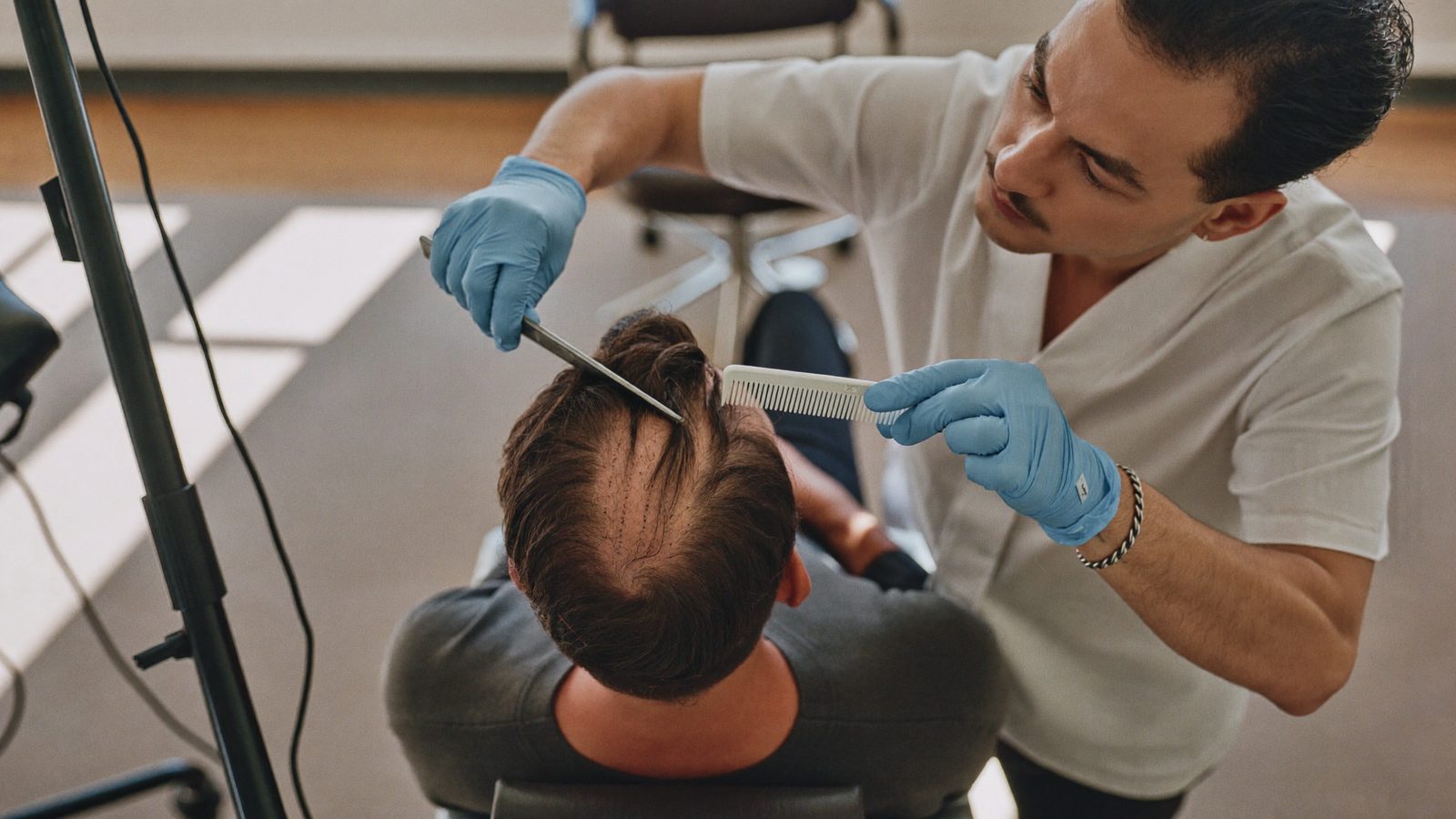
A crown hair transplant can restore a thinning or bald vertex, but it asks more of you than a frontal procedure does: more grafts for the same visual density, a slower growth curve, and a clear plan for the hair loss that may still be underway around it. Most crown work on Long Island is done with follicular unit excision, and our manual FUE procedure in Melville explains the harvesting side in detail. This article stays on the back of the head, where the scalp behaves differently from the front.
In consultations we hear the same worry again and again. People notice the spot in a photo taken from above, or under a bathroom light, and want it gone quickly. The honest answer is that the crown is treatable, but the timing, the angle work and the long-term graft budget matter more here than almost anywhere else on the scalp. Below we walk through why the vertex thins, how a natural swirl is rebuilt, how crown work compares with hairline work, when to hold off, and what the mirror shows you month by month.
Quick Answer: The Crown Responds to FUE, on a Longer Timeline
Yes, the crown can be restored with FUE, but it typically needs more grafts and more patience than the hairline. The follicles moved to the vertex come from the same permanent donor zone at the back and sides of the head, so once they settle in they keep growing the way they did in the donor area. What differs is the surface they are placed into and the way light and viewing angle reveal that surface.
Three facts shape almost every crown plan we build:
- The area is round and wide. A vertex bald spot is a disc, often larger than it looks in the mirror, and its edges keep growing outward if the underlying loss is active.
- Hair radiates from a center point. Grafts have to fan out in a spiral, so many of them lie flatter and point in different directions, which changes how much scalp each hair covers.
- Growth shows up later. Crown grafts commonly look sparse at the point where frontal grafts already look full, and the final look can take up to around 18 months.
Key point: The crown is not a lower-quality result area. It is a slower and more graft-hungry one. People who know that going in tend to be far happier with the outcome than people who expect the front-of-head timeline.
Why the Vertex Thins and Why It Is Harder to Cover
The crown usually thins because of androgenetic alopecia, the same inherited sensitivity to DHT that drives a receding hairline. In the Norwood scale used by clinicians, vertex loss appears as its own pattern (the "V" variants and the higher stages), and many people lose hair at the crown and the front at the same time until the two zones eventually meet. The American Academy of Dermatology describes this pattern as progressive, which is exactly why the crown needs a plan rather than a single fix.
The bald spot is a moving target
A receding temple tends to stop at a fairly predictable line. A thinning crown does not have a natural edge. It expands outward in a ring, and the hair around it often miniaturizes for years before it disappears. If grafts are packed into the visible bald spot alone, the native hair surrounding them can keep thinning, leaving a ring of sparse scalp around a transplanted island. We call this the "halo" problem, and avoiding it is the main reason crown plans are more conservative than people expect.
Light, angle and scalp contrast
The vertex sits at the highest point of the head, so it is lit from above by almost every ceiling light and by the sun. Hair at the crown also lies at a low angle and parts naturally at the swirl. Put those together and you get maximum scalp show-through for any given number of hairs. A hairline is mostly viewed from the front, where hairs overlap each other in layers. The crown is viewed from above and behind, where each hair is seen more nearly end to end.
Why the same graft count looks thinner at the back
Because crown hairs fan outward from a center, they do not stack in rows the way frontal hairs do. Each hair covers a small strip of scalp in its own direction, and neighboring hairs point away from one another rather than shingling. That is why, for the same graft count per square centimeter, a crown reads less dense to the eye than a frontal zone. For the planning math across the whole scalp, our guide on estimating your graft count covers zone sizes and density targets, so we will not repeat those tables here.
Recreating the Whorl: Angle and Direction at the Vertex
A natural crown depends on rebuilding the whorl, the spiral point where hair changes direction, with grafts angled low and rotated to follow that spiral. This is the single most technical part of vertex work. If the direction is wrong, the result can look like hair standing up in tufts or pointing in a straight line backward, which reads as artificial even when density is good.
Finding the original swirl
Most people have one whorl, some have two, and the direction (clockwise or counterclockwise) varies from person to person. In an assessment we look for remnant hairs and the faint pattern of miniaturized hairs, because these usually still show the original flow even when the area looks bald from a distance. Where nothing is left to read, the swirl is placed slightly off center and to one side, which is where it sits on most scalps, and the direction is chosen to match the way the surrounding native hair already lies.
How sites are angled around the center
Recipient sites are made at a shallow angle so hairs lie close to the scalp, and the direction of each site rotates gradually as it moves around the center point. Near the middle of the whorl, hairs spiral tightly. Further out, they open into longer sweeps that blend into the hair flowing down toward the nape and forward toward the mid-scalp. Our in-house team works through these zones in a set order so the rotation stays consistent across the whole disc.
Graft size and placement
Single-hair grafts are typically used right at the center of the whorl, where a heavy multi-hair graft would look like a plug. Two and three-hair grafts are usually placed in the outer ring, where they add bulk without disrupting the swirl. Under the Nova Medical FUE Protocol, grafts are kept chilled between extraction and placement and the spacing is planned in advance, which matters at the vertex because sessions here can be long and grafts spend time out of the body.
Key point: Density gets the attention, but direction decides whether a crown looks natural. A moderate number of correctly angled grafts usually looks better than a high number placed without regard to the swirl.
Crown vs. Hairline: Grafts, Growth Time and Priority
Compared with the hairline, the crown usually needs a larger share of grafts for the same visual result, grows in more slowly, and comes second in priority for most people. The table below summarizes how the two zones differ in practice. It is a comparison of behavior, not a graft calculator.
| Factor | Hairline and frontal zone | Crown (vertex) |
| Typical shape of the area | Narrow band with a defined front edge | Round disc that can keep widening |
| Main viewing angle | Face to face, front and three-quarter views | From above and behind, under overhead light |
| Hair direction | Mostly forward, layered rows that overlap | Spiral around a whorl, hairs fan apart |
| Grafts for similar visual density | Fewer per square centimeter of visible effect | More, because hairs overlap less |
| When growth becomes visible | Often from about month 3 to 4 | Often closer to month 4 to 6 |
| When the final look settles | Around 12 months for many people | Around 12 to 18 months, sometimes later |
| Risk of ongoing loss around the grafts | Present, but the edge is more predictable | Higher, the ring of native hair often keeps thinning |
| Usual priority in a limited graft budget | First, because it frames the face | Second, sometimes partial coverage only |
The last row is the one that surprises people. Over a lifetime, the donor area can typically supply something like 5,000 to 7,000 grafts depending on density, and both the front and the crown can draw heavily on that supply if loss progresses. Spending a large share on the vertex at a young age can leave too little for the front later. That is why, for most people with both front and crown loss, Dr. Prokurat directs the plan so the frontal third comes first and the crown is approached in a measured way, either in the same session at a lower density or in a later session once the pattern is clearer. How these priorities fit into a broader men's plan is covered in our overview of hair restoration options for men on Long Island.
What "partial coverage" means in practice
Partial coverage does not mean leaving the crown alone. It often means placing enough grafts to remove the obvious scalp shine and restore the swirl, without trying to match the density of a full head of hair. Many people find that this level of coverage is all they wanted in the first place, because it is the shine under overhead light that bothers them rather than a precise hair count.
When to Treat the Crown Now and When to Stabilize First
Treat the crown surgically when the loss pattern has slowed and the donor supply can support it; stabilize it first with medical therapy when the area is still actively thinning. In our Long Island consultations this is the most important decision in crown planning, more important than the technique itself.
Signs the crown may be ready for grafts
- Your loss has been fairly stable for a period of time, rather than visibly worsening season to season.
- You are past the age range where loss tends to move fastest, or your family pattern suggests a limited final extent.
- Your donor density is good enough to cover the front now and leave reserve for later.
- You are already using, or are willing to use, medical treatment to protect the native hair around the grafts.
Signs it is better to wait
- You are in your early twenties with fast, recent loss at the vertex.
- The thinning ring around the bald spot is wide and still miniaturizing.
- Your donor area is limited and would be strained by doing both front and crown.
- You expect the crown to look like it did at eighteen and are not open to moderate density.
The role of medication and PRP
The vertex is the area where FDA-approved treatments are generally considered to work well, which is one more reason the crown is often stabilized before surgery. Finasteride and minoxidil are the two FDA-approved medications for pattern hair loss, and whether either suits you is a conversation to have with your physician, since both have side effects and considerations that need individual review. We cover how they fit around surgery in our article on medication after a transplant. Some people also add PRP treatment for thinning hair, which uses your own platelet-rich plasma and is offered at our Melville clinic. PRP does not replace grafts on a bald crown, but it may help support miniaturizing native hair in the surrounding ring.
A common sequence looks like this: medical treatment for a period first, a reassessment to see how the crown has responded, and then grafts placed into whatever remains thin. Sometimes the reassessment shows that far fewer grafts are needed than the first impression suggested. Sometimes it shows that loss is still advancing and surgery should wait longer.
Key point: A transplant moves permanent hair into the crown, but it does not stop the native hair around it from thinning. Protecting that surrounding hair is what keeps the result from turning into an island.
Who Is Not a Good Candidate for Crown Grafts
Crown surgery is not the right choice for everyone, and saying no, or not yet, is part of a responsible plan. The main reasons we advise against vertex grafts, at least for now, are a weak donor area, very advanced loss where the front would be left uncovered, rapid early loss, and unrealistic expectations about density.
Very advanced patterns deserve special attention. When the front, mid-scalp and crown are all thin, the available grafts may only cover the front and middle convincingly. Spreading them across the whole top of the head can leave everything looking thin at once. In those cases, a strong frontal result with a lighter or deferred crown usually looks better than an even, sparse coverage across the entire area.
Scalp conditions matter too. Active inflammation, scarring conditions or diffuse thinning that also affects the donor zone can rule out surgery or change the approach. These are assessed in person, because they are hard to judge from photos. If you have had a previous crown procedure that looks unnatural, such as grafts pointing straight back or visible clusters, our team can also assess whether corrective work is possible.
What Crown Results Look Like at 6, 12 and 18 Months
At 6 months most crowns show early, fine growth; at 12 months the area usually looks clearly fuller; and by 18 months the crown has typically reached its final density and texture. These are typical ranges, and your own timeline can run faster or slower.
The first weeks
After a crown session, small scabs form around each graft and usually clear within the first one to two weeks. Between about 2 and 6 weeks, most transplanted hairs shed. This is expected. The follicle stays in place under the skin and enters a resting phase before producing new hair. Sleeping position matters more after crown work than after frontal work, because the back of the head is what rests on the pillow, and you will receive specific aftercare instructions for those first nights.
Month 3 to month 6
New hairs start to break through, often first at the outer ring and later near the center of the whorl. At this stage the crown can look patchy and thin, and many people feel discouraged. That feeling is normal. The new hairs are fine and short, and they have not yet grown long enough to lie down along the spiral and cover the scalp.
Month 6 to month 12
This is when most people notice a real change. Hairs thicken, lengthen and begin to follow the swirl, and the scalp shine under overhead light starts to fade. Photos taken from above at the same spot and in the same light are the most useful way to track progress, because the mirror rarely shows the vertex accurately.
Month 12 to month 18 and beyond
Crown hair often keeps maturing after the front has settled. Texture improves, individual hairs gain caliber, and the swirl looks more defined. We generally recommend waiting until at least 12 months, and often closer to 18, before judging the crown or deciding whether a second session would add value.
Planning a Crown Procedure From Long Island
A crown plan starts with a free assessment at our clinic at 445 Broadhollow Rd on Route 110 in Melville, which is a short drive off the Long Island Expressway for people coming from across Nassau and Suffolk counties. During the visit, our team examines the crown and the donor area under magnification, looks at the surrounding ring for miniaturization, and photographs the vertex from above so changes can be compared over time.
Dr. Val Prokurat, MD reviews every plan and decides with you whether the crown should be treated now, treated partially, or stabilized first. You leave with a written quote based on the actual graft estimate. Our published pricing runs from $3.99 to $7.99 per graft, most procedures total $4,000 to $15,000, there are no session fees, and 0% interest financing is available for the first 12 months. The full breakdown is on our hair transplant pricing page.
Questions worth bringing to the assessment include: how wide your crown area actually measures, how much donor reserve would be left after treating the front, what density is realistic for your hair caliber and color, and how long you should wait on medical therapy before grafts are placed. Clear answers to those four questions usually make the decision straightforward.
Patience Is Part of the Plan
The crown is often the area people worry about most and the area that rewards a slower, more deliberate plan. It typically needs more grafts for the same look, careful rebuilding of the swirl, protection of the native hair around it, and up to a year and a half before the final result can be judged. When those pieces are respected, a restored vertex can look natural from above, under bright light and at close range. If the back of your head is what you notice first in photos, a calm assessment with real measurements is the right next step, rather than a rushed decision about graft numbers.
Medically reviewed by Dr. Val Prokurat, MD. Dr. Prokurat is a physician with advanced training in minimally invasive techniques who reviews and oversees every treatment plan at Nova Medical Hair Transplant Long Island, 445 Broadhollow Rd in Melville. This article is for general education and is not a substitute for an in-person medical assessment. Individual results vary. Read more about Dr. Prokurat.
Find Out What Your Crown Needs
Our Long Island team will measure your crown, check your donor reserve and tell you honestly whether to treat the vertex now or stabilize it first.