
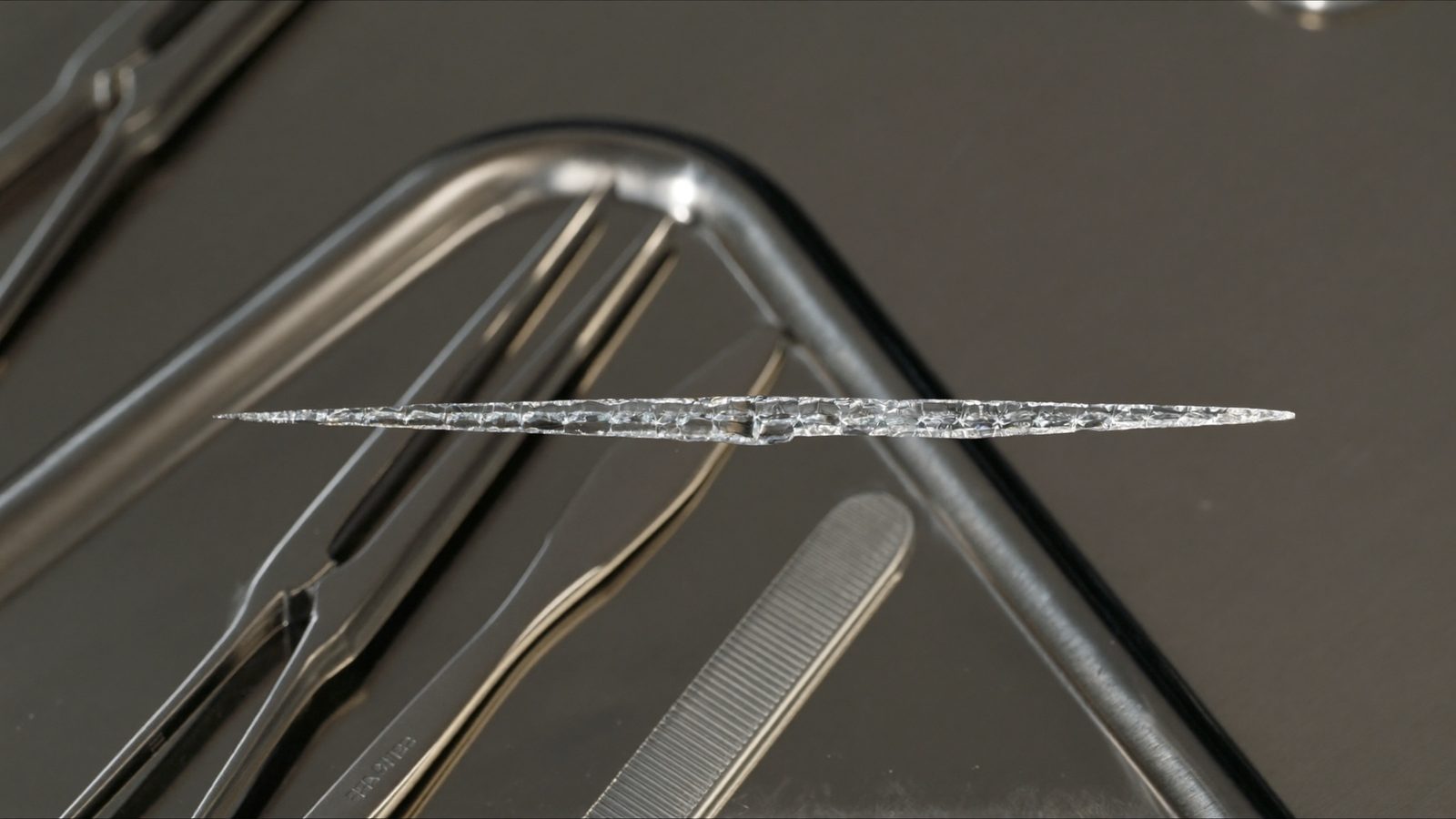
Sapphire FUE is a follicular unit extraction transplant in which the tiny openings that receive your grafts are made with a blade tipped in synthetic sapphire instead of surgical steel. That is the whole difference. The donor hair is harvested the same way, the grafts are sorted and stored the same way, and they are placed into the scalp the same way. Only the instrument that cuts the recipient sites changes.
We hear the term in consultations more and more, usually after someone has seen it advertised as a "new kind" of transplant. It is not a new procedure. It is one detail inside a standard FUE, and like most details, it matters a little in some cases and not much in others. This guide explains where the blade is used, what a sharper or finer cutting edge can realistically change, what it cannot change at all, and the questions that tell you far more about a clinic than the material of its blades.
What "sapphire FUE" actually means
An FUE transplant has two technical halves. First, individual follicular units (natural groups of one to four hairs) are removed from the donor area, usually the back and sides of the scalp. Second, small incisions called recipient sites are opened in the thinning or bald area, and each graft is set into one of those sites.
The phrase "sapphire FUE" refers only to the second half. The surgical team uses a small blade whose cutting tip is made from synthetic sapphire crystal, a very hard material that can be ground to a fine, smooth edge. Standard FUE typically uses steel micro-blades or fine hollow needles for the same job. Both create a small slit or channel in the skin. Neither touches the donor area.
So when a clinic says "sapphire FUE," what you are really being told is: "we perform an FUE transplant, and we open the recipient sites with sapphire-tipped blades." It is a fair thing to describe, but it should not be confused with a different extraction method or a different kind of result.
Key point: Sapphire FUE and standard FUE use the same extraction, the same graft handling and the same placement. The blade only changes how the small openings in the recipient area are made.
Where the blade is used in the procedure
It helps to see the whole day laid out, because it shows how much of the outcome depends on steps the blade never touches. A typical FUE day, whether sites are cut with sapphire, steel or needles, follows five stages:
- Consultation and plan. Your hair loss pattern, donor density, age and goals are assessed, and a hairline and graft distribution plan is drawn. At our clinic, every plan is reviewed and directed by Dr. Val Prokurat, MD.
- Extraction. The donor area is trimmed and numbed, and follicular units are removed one at a time with a small punch. On Long Island we use manual FUE with motorized handheld tools, not a robot.
- Recipient site creation. This is the only step where "sapphire" applies. Tiny incisions are made at a chosen angle, direction and depth that will decide how each hair grows out.
- Implantation. Grafts are placed into the sites with fine forceps, or loaded into an implanter pen in a DHI-style approach.
- Recovery. Small scabs form and fall away over roughly 7 to 10 days, shedding often follows at 2 to 6 weeks, and new growth usually starts around month 3 to 4.
Site creation is genuinely important. The angle and direction of each incision decide whether the finished hair lies flat and natural or sticks out at an odd angle. The density of the sites decides how full an area looks. The depth and width decide how snugly a graft sits. But notice that all of those qualities come from the hand and the plan, not from the crystal. A well-placed steel incision beats a carelessly placed sapphire one every time.
Possible benefits: site size, healing and density
Supporters of sapphire blades point to a handful of potential advantages. They are worth understanding, along with the honest caveats attached to each.
A finer, smoother cut
Sapphire is harder than steel and can hold a very sharp, polished edge. In principle, a sharper edge parts tissue with less tearing, which can mean a cleaner, more precise slit. Some surgeons find sapphire blades easier to use for very small, consistent openings. The counterpoint is that fresh, high-quality steel blades are also extremely sharp, and teams that change blades often get very clean cuts from steel as well.
Potentially less tissue trauma
A cleaner incision may cause slightly less disruption to the surrounding skin and small blood vessels. In theory that could mean a little less redness, less swelling and faster closure of the sites. In practice, healing speed also depends heavily on how many sites are made, how close together they are, how carefully the scalp is handled, and how well you follow aftercare instructions. Many patients heal quickly after steel-blade FUE, and some heal slowly after sapphire. The difference, where there is one, tends to be modest.
Tighter graft spacing
Because sapphire blades are often made in very small, precise sizes, some clinics say they allow sites to be placed closer together, which could support higher density in a single session. That is plausible in skilled hands, but density has a ceiling that no blade can lift. Packing sites too tightly can strain the blood supply that new grafts depend on in the first days, and the total number of grafts is set by your donor area, not by the instrument. Spacing should follow the plan, the skin quality and the graft count, rather than being pushed simply because a finer tool makes it possible.
Fit for different hair types
Fine, straight, wavy, coarse or curly hair can all be transplanted with recipient sites made by sapphire or steel. What changes from one hair type to another is the angle, the size of the opening relative to the graft, and how the extraction punch is handled. Curly hair, for example, curves below the skin and needs careful extraction regardless of which blade opens the recipient sites.
What the blade can't fix: planning, donor supply and graft handling
This is the section we spend the most time on with patients, because it is where expectations go wrong. A recipient-site tool is the last few millimeters of a long chain of decisions. If the earlier links are weak, the blade cannot rescue the result.
- Graft count. The number of grafts you receive is decided by your goals, the area to cover and how much donor hair can safely be removed. The blade does not create more grafts.
- Donor limits. Over a lifetime, most people have roughly 5,000 to 7,000 grafts available, depending on density. Over-harvesting thins the back of the scalp. No site-making tool changes that budget.
- Graft survival. Grafts are living tissue. How quickly they are handled, how they are kept moist and cool outside the body, and how gently they are placed affect survival far more than the incision material. This is why the Nova Medical FUE Protocol emphasizes chilled graft storage and careful handling.
- Hairline design. A hairline that is too low, too straight or too dense for your age and future loss will look wrong in ten years, however clean the incisions were.
- Ongoing hair loss. A transplant moves hair; it does not stop pattern loss elsewhere on the scalp. Medication or PRP may be part of protecting native hair. Talk to your physician about whether finasteride or minoxidil fits your situation.
- Final density. The look of the finished result comes from graft count, distribution, hair caliber and color contrast with your skin. The blade influences only how neatly each graft sits.
When someone asks us whether a sapphire blade will give a "better result," we usually turn the question around: which part of the result are you worried about? If it is naturalness, that is about design and angle. If it is fullness, that is about donor supply and planning. If it is recovery, that is about technique, site count and aftercare. Each of those has a clearer answer than the blade does.
Sapphire vs. steel vs. DHI implanter at a glance
Three approaches to the recipient area come up often. Here is how they compare in plain terms. The details vary between clinics, so treat this as a general picture, not a promise for any one case.
| Feature | Sapphire blade | Steel blade or needle | DHI implanter pen |
| What it does | Opens recipient slits before placement | Opens recipient slits or channels before placement | Creates the site and places the graft in one motion |
| Extraction method | Standard FUE | Standard FUE | Standard FUE |
| Edge or tip | Very hard, polished crystal edge | Sharp surgical steel, often replaced during the case | Hollow needle inside the pen |
| Main appeal | Fine, consistent openings | Proven, widely used, flexible sizing | Control of angle and depth, useful for dense packing in small zones |
| Typical tradeoffs | Can add cost at some clinics; benefit depends on the team | Quality depends on blade freshness and technique | Slower for large sessions; requires a trained team |
| Changes graft count? | No | No | No |
| Changes donor limits? | No | No | No |
If you want to compare implanter-based placement in more depth, our page on DHI hair transplants explains how the pen works and when we use it. For most patients, the right choice among these comes down to the area being treated, the number of grafts, hair characteristics and the experience of the team, rather than one tool being superior across the board.
How our Long Island team approaches the recipient area
At our Melville clinic, we perform manual FUE with motorized handheld tools, FUT (strip) and DHI, and we offer PRP. If you are curious about the specific instruments our team would use for your recipient sites, ask at your assessment; we are happy to show you and explain why. What we focus on when planning the recipient area is more practical than the blade's material:
- Direction and angle that match your native hair. At the hairline, hairs usually lie forward and low; at the crown, they swirl. Sites follow that pattern so the result blends in.
- Site size matched to graft size. Single-hair grafts go into the smallest openings along the front edge, with larger multi-hair units behind them for body.
- Spacing set by the plan. We place sites densely where it counts and avoid crowding that could compromise blood supply.
- Short time out of the body. Grafts are kept chilled and placed promptly, which matters more for survival than any single instrument.
Our in-house team of experienced technicians works under treatment plans overseen by Dr. Prokurat, so the person who reviewed your plan is accountable for how it is carried out. You can read more about the main procedure on our FUE transplant page, and see examples of finished hairlines in the patient gallery.
Recovery after FUE, whichever blade is used
A common reason people look for sapphire FUE is the hope of a faster, easier recovery. The truth is that recovery after any modern FUE is usually manageable, and the overall timeline is much the same regardless of the recipient-site tool.
- Days 1 to 3: mild tightness, some swelling that can travel down toward the forehead, and small crusts at each site.
- Days 7 to 10: most crusts soften and wash away with gentle care; the donor area looks like short, closely trimmed hair.
- Weeks 2 to 6: many transplanted hairs shed. This is expected; the follicles stay in place.
- Months 3 to 4: new hairs begin to appear, often fine at first.
- Months 12 to 18: the final result settles as hairs thicken and lengthen.
A cleaner incision may shorten the redness or crusting phase a little for some patients, but it will not shorten the growth cycle. Hair follicles take months to produce visible hair no matter how the site was opened. Our hair transplant recovery guide covers washing, sleeping, exercise and when most people return to work.
Key point: No recipient-site tool speeds up hair growth. Expect the same 12 to 18 month path to your final result with sapphire, steel or an implanter pen.
Cost: does the blade change the price?
At some clinics, "sapphire FUE" is sold as a premium tier with a higher price. Before paying more for a specific instrument, it is worth asking exactly what the extra cost buys. If the extraction, the team, the graft handling and the plan are the same, you are paying for one tool in one step.
Our pricing on Long Island is per graft, from $3.99 to $7.99, and most procedures total between $4,000 and $15,000. There are no session fees, and 0% interest financing is available for the first 12 months. You get a written quote after a free assessment, so you can see what is included before deciding. The cost page explains what moves a quote up or down, such as the number of grafts and the technique.
A simple rule of thumb: pay for the things that most affect your result, which are planning, the team's experience, graft handling and an honest assessment of your donor area. Treat the blade as a detail you can ask about, not the main reason to choose a clinic.
Who should care about the recipient-site tool, and who should not
For most people with ordinary pattern hair loss, the choice between sapphire and steel blades will not be the deciding factor in how the result looks. There are a few situations where the recipient-site approach deserves a closer conversation:
- Hairline refinement with many single-hair grafts. Very small, consistent sites matter most at the front edge. Ask how the team sizes them.
- Adding density between existing hairs. When native hair is still present, sites have to be placed carefully to avoid damaging it. Precision tools and steady technique both help.
- Repair of an older transplant. Scarred or previously grafted skin behaves differently. Our repair page explains how those cases are planned.
- Eyebrow and beard work. These areas need tiny, sharply angled sites, so the team's precision with whatever instrument it uses is especially important.
On the other hand, you are probably not a good candidate for any FUE, sapphire or otherwise, if your donor area is very thin, if your hair loss is extremely early and unpredictable, or if a medical condition causes diffuse shedding that has not been diagnosed. In those cases, medical treatment or PRP and a period of monitoring often come first.
Questions to ask a clinic about recipient sites
If you are comparing clinics, these questions reveal more than "do you use sapphire blades?":
- Who designs my hairline, and who reviews the final plan?
- How many grafts do you recommend, and how much donor supply will that leave for the future?
- How do you decide site size, angle and direction for different zones of my scalp?
- How are grafts stored while they are outside the body, and for how long?
- Who on the team makes the recipient sites, and how experienced are they?
- Does a specific instrument change the price, and if so, why?
- Can I see results from patients with hair similar to mine?
- What does follow-up look like over the first year?
A clinic that answers these clearly and specifically is showing you how it works. A clinic that keeps returning to the blade may be selling a feature rather than a plan.
Related reading and next steps
Recipient-site tools are one of several topics where marketing language can run ahead of the evidence. If you are also weighing regenerative treatments, our explainer on how platelet-rich fibrin compares with PRP sets out what is known. If you have read claims about growing new hair in a lab, our update on the state of hair cloning research separates research from what is available today. And if you are a man trying to work out what your stage of loss calls for, our stage-by-stage planning guide for men walks through medication, FUE, FUT and staged sessions.
Our clinic is at 445 Broadhollow Rd on Route 110 in Melville, a short drive from the Long Island Expressway and the Northern State Parkway, which makes it convenient for patients from both Nassau and Suffolk counties. We are open Monday to Friday, 9am to 6pm. Your free assessment includes a scalp and donor evaluation, a discussion of your goals, and a written plan and quote. If you want to understand the instruments involved, bring the questions above, and our team will walk you through every step of the day, including how your recipient sites would be made.
The bottom line on sapphire FUE: it is a legitimate refinement of one step in an FUE transplant, and it may offer a finer cut in skilled hands. But the result you see in a year comes from the plan, the donor hair, the handling of every graft and the experience of the people doing the work. Choose a clinic for those, and the choice of blade becomes a detail you can discuss with confidence.
Medically reviewed by Dr. Val Prokurat, MD. Dr. Prokurat is a physician with advanced training in minimally invasive techniques who reviews and oversees every treatment plan at Nova Medical Hair Transplant Long Island, 445 Broadhollow Rd in Melville. This article is for general education and is not a substitute for an in-person medical assessment. Individual results vary. Read more about Dr. Prokurat.
Plan your FUE with our team
The blade is one detail; the plan is what shapes your result. Book a free assessment in Melville for a donor evaluation, hairline plan and written quote.