
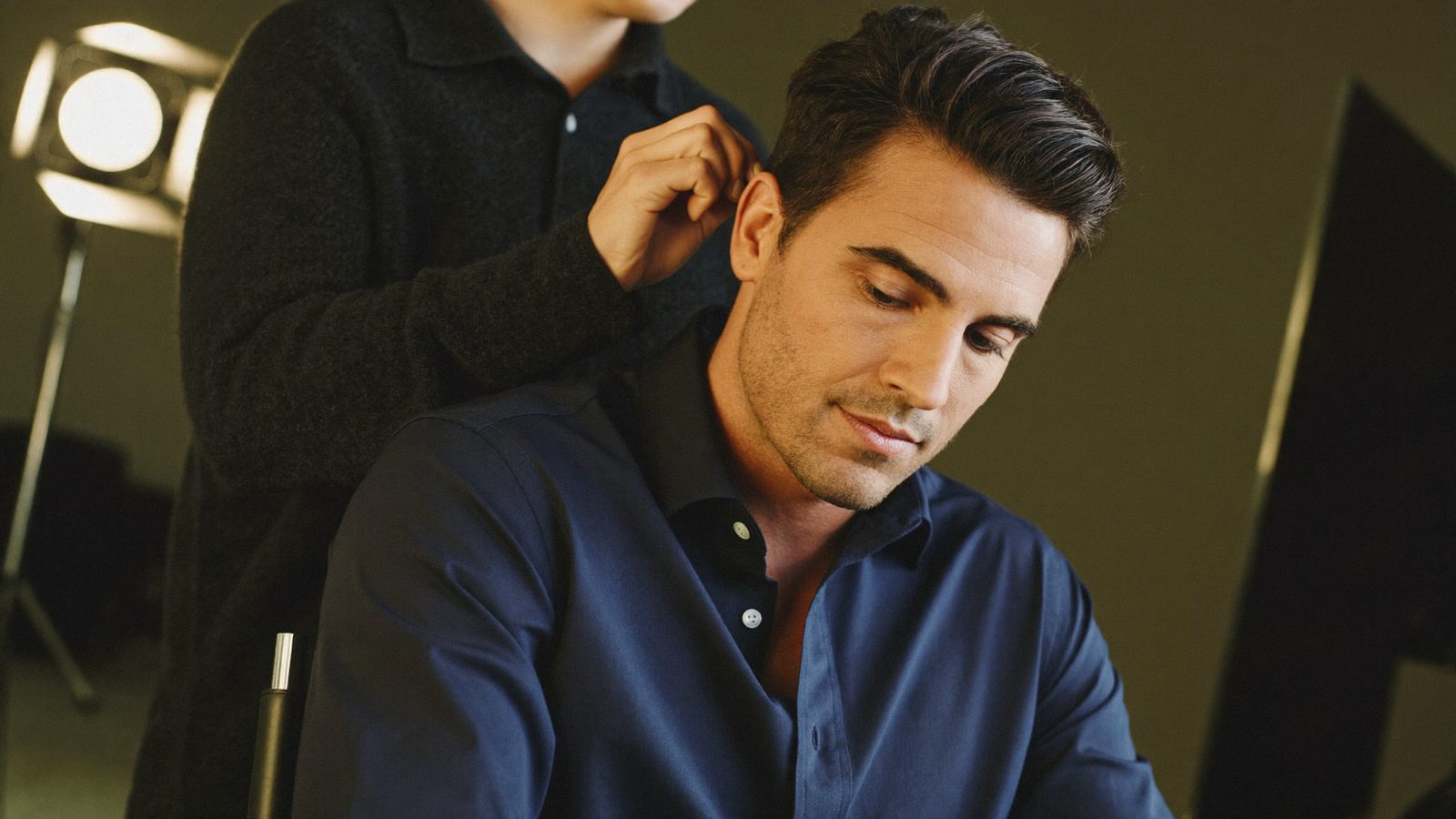
Celebrity hair looks good for reasons that have less to do with fame than most people assume. A camera-ready hairline is usually the product of careful design, soft single-hair grafts at the very front, sensible density planning, steady maintenance and, on screen, professional lighting and grooming. In consultations at our Long Island clinic, a photo of a famous face is one of the most common things patients bring in. That is a perfectly good starting point. Our job is to explain which parts of that look are achievable with your own donor hair, your age and your pattern of loss, and which parts belong to a styling team and a ring light.
This guide walks through what actually makes a public hairline look so convincing, how a natural front edge is designed, why two people with the same reference photo end up with different plans, and how to set a goal you will still like in 20 years. We never discuss or speculate about any real person's hair, and nothing here suggests that anyone famous has been treated at our clinic. We talk about patterns you can see in public, in general terms.
Why famous hairlines look "perfect"
When a hairline looks flawless in a magazine or on a red carpet, several things are usually working at once. Some of them are medical. Many are not.
- Professional grooming. Haircuts are often refreshed every week or two before appearances. A fresh cut makes any hairline look sharper and fuller, transplanted or not.
- Styling products. Fibers, matte pastes, volumizing sprays and blow-drying add apparent density. Hair that is lifted and textured covers more scalp than hair lying flat.
- Lighting and angles. Studio light is soft and comes from the front. Overhead light, the kind you meet in an elevator or a bathroom, is what exposes thinning. Photos are also chosen; you rarely see the unflattering frames.
- Makeup and scalp tinting. Reducing the contrast between scalp and hair is one of the oldest tricks for making thin areas disappear on camera.
- Early, consistent medical care. People whose appearance is their work tend to act early, often starting medication before loss is obvious. Preserving existing hair is far easier than replacing it.
- Good genetics. Some people simply have dense, coarse, wavy hair with a strong donor area. That raw material makes every technique look better.
Key point: A photo shows the best minute of the best day, after grooming and under ideal light. Use reference images for the shape and character of a hairline, not as a measure of density you should expect in daily life.
None of this means a reference photo is useless. It tells us a lot about what you like: a straight or slightly rounded front, a soft or defined edge, a mature or youthful position. Those preferences are exactly what a good plan starts from.
The design choices behind a natural front edge
The hairlines people admire share a handful of design features. These are the same principles our Long Island team uses when drawing a plan, and they are what separate a result that reads as natural from one that reads as "done".
Irregularity, not a ruler line
A natural hairline is never perfectly straight. Look closely at any untreated hairline and you will see small zigzags, tiny gaps and stray hairs a few millimeters ahead of the main line. Planners call this the transition zone. Recreating it is one of the most important parts of the design, because a hard, even edge is the clearest giveaway of an older or poorly planned transplant.
Single-hair grafts at the very front
Follicular units naturally contain one, two, three or sometimes four hairs. The first rows of a natural hairline are made almost entirely of single-hair units, with two-hair units behind them and the denser multi-hair units further back. Sorting grafts by hair count and placing them in that order gives the soft-to-full gradient that looks right from a conversation distance and in close-up photos.
Angle and direction
Front hairs grow forward and at a low angle to the scalp, often with a slight swirl to one side. Grafts placed too upright look like tufts, even when density is good. Direction is planned for each zone, which is why recipient sites are made with care rather than speed.
Temples and the frontal-temporal angle
The temples frame the face. Many admired hairlines have filled temporal points and a gentle recession where the front meets the temples. Overfilling this angle into a straight band across the forehead tends to look juvenile and unnatural on adult men.
Height that fits the face
A hairline set too low may look great at 28 and odd at 55. Our plans usually place the front edge where it frames the upper third of the face and still makes sense as you age. A slightly mature position is almost always the safer choice.
Density, donor limits and why everyone's result differs
Two people can bring in the same photo and leave with very different plans. The deciding factors are biology and arithmetic, not effort or budget.
Your donor area, the band of hair at the back and sides of the scalp, is the only source of grafts for a scalp transplant. Hairs from this zone are generally resistant to the hormone-driven miniaturization behind male pattern hair loss, which is why they keep growing after they are moved. But the supply is finite. A typical lifetime donor budget is roughly 5,000 to 7,000 grafts, depending on density, and every graft spent on the hairline is a graft not available for the crown later.
| Factor | Helps the "camera-ready" look | Makes it harder |
| Hair caliber | Coarse, thick individual hairs | Fine hair that shows more scalp |
| Hair texture | Wavy or curly hair that covers more area | Very straight hair that lies flat |
| Hair and skin color | Low contrast (light hair, light skin; dark hair, darker skin) | High contrast (dark hair on pale skin) |
| Donor density | Dense donor area with many multi-hair units | Sparse donor area that limits graft numbers |
| Age and stability | Loss that has slowed and is being treated | Young age with rapid, ongoing loss |
| Extent of loss | Recession limited to the front and temples | Front, mid-scalp and crown all thinning |
Density is also an illusion to a degree. A transplanted area does not need to match original density to look full. In practice, the eye reads a well-designed front at roughly half of native density as a full head of hair, especially with good hair caliber and low contrast. That is why our planners concentrate density where it matters most, at the front and the part line, and accept lower density in less visible zones.
If you are earlier in the process and want a broader picture of options at each stage, our guide to planning a transplant at every stage of hair loss covers how the Norwood scale shapes a plan.
Which techniques produce a refined hairline
There is no technique reserved for famous faces. The results people admire come from planning and execution, and several approaches can deliver them.
- FUE (follicular unit excision). Individual follicular units are removed one at a time from the donor area. At our clinic, this is done manually with motorized handheld tools, not a robot. FUE leaves tiny dot scars and suits people who like to wear their hair short at the back and sides. Our FUE procedure page explains the steps in detail.
- FUT (strip). A thin strip of donor scalp is removed and divided into grafts under magnification. It leaves a linear scar but can yield a high number of grafts in one session, which helps when a large area needs coverage.
- DHI (implanter pen). Grafts are loaded into a pen-style implanter and placed directly, which gives fine control over angle and direction. Some patients and planners favor it for hairline work.
Across all three, the elements that matter for a natural front edge are the same: graft sorting, careful handling, chilled graft storage between extraction and placement, and spacing that respects blood supply. These are central to the Nova Medical FUE Protocol, under which every treatment plan is reviewed and overseen by Dr. Val Prokurat, MD.
You may also read about newer tools in the media. Recipient-site blades are one example, and our article on how sapphire and steel blades compare explains what that tool choice changes and what it does not. Lab-grown hair is another topic that comes up often; our look at where hair cloning research stands sets out why it is not a treatment option today.
Maintenance: medication, PRP and follow-ups
One of the most overlooked parts of any admired hairline is what happens after surgery. Transplanted hair is durable, but the native hair around it keeps responding to your genetics. Without maintenance, it can thin behind a transplanted front, leaving an island of hair that looks strange over time.
Medication
Finasteride (a prescription tablet) and minoxidil (a topical solution) are both FDA-approved for male pattern hair loss. Finasteride reduces the hormone that drives miniaturization; minoxidil supports growth at the follicle. Oral minoxidil is used off-label and only under a physician's direction. Both have possible side effects and are not right for everyone, so talk to your physician before starting or stopping either.
PRP
Platelet-rich plasma uses a concentrate from your own blood, injected into the scalp to support thinning follicles. Some patients use it alongside medication or as part of post-transplant care. Our page on PRP for hair loss covers how sessions work and who tends to benefit. If you have read about a related preparation, our explainer on how PRF differs from PRP walks through the differences.
Follow-ups and patience
Transplanted hairs usually shed at 2 to 6 weeks, start to grow from about month 3 to 4, and reach their final look around 12 to 18 months. The hairlines you admire in public have usually had time to mature. Judging your own result at month four, before most grafts have grown, is a recipe for needless worry. Regular check-ins let our team track progress and adjust your maintenance plan.
Key point: A hairline is a long-term project. Surgery restores the front; medication, PRP where appropriate, and periodic reviews protect the hair around it.
When a "celebrity look" is the wrong goal
We are direct about this in consultations, because a mismatched goal is the most common cause of disappointment. A celebrity-inspired plan may not be right for you if:
- You are very young with active loss. In your early twenties, loss pattern is hard to predict. A low, dense hairline built now may be stranded if the hair behind it continues to recede. Medical treatment and a period of monitoring often make more sense first.
- Your donor supply is limited. If your donor area cannot support both a dense front and future crown work, a conservative hairline protects your options.
- The reference hairline is lower than your natural one ever was. Rebuilding the hairline you had at 18 is often reasonable. Creating one you never had rarely ages well.
- The look depends on styling you will not do. If the photo relies on a full blow-dry and product, but you plan to wash and go, the result will look different in your daily life.
- You expect one session to match a photo exactly. Some goals need two procedures spaced at least a year apart, and some are simply beyond what donor hair can supply.
People with diffuse thinning across the whole scalp, certain scalp conditions, or unstable medical issues may not be good surgical candidates at all. In those cases our team will say so and discuss non-surgical options instead.
A better goal is usually to aim for the character of a reference hairline, the soft edge, the framed temples, the natural direction, at a height and density your own hair can support. That kind of result tends to look good in person, under any light, without a styling team.
How we plan your own result in Melville
Here is how a planning visit at our Long Island clinic typically runs:
- Bring your references. Photos of hairlines you like, and old photos of your own hair, both help. We discuss what draws you to each image: shape, height, texture or fullness.
- Scalp and donor assessment. We look at your pattern of loss, hair caliber, donor density and scalp condition, and estimate how many grafts your donor area can reasonably provide over your lifetime.
- Hairline drawing. A proposed hairline is drawn on your scalp so you can see it in a mirror from several angles. This is where reference images become a realistic design.
- Technique and graft estimate. We explain whether FUE, FUT or DHI suits your case, roughly how many grafts are involved, and whether a second session is likely to be part of the long-term plan.
- Maintenance discussion. We cover medication, PRP and follow-ups, and encourage you to talk to your physician about any prescription options.
- Written quote. You receive a written quote after the free assessment, with no pressure to decide on the day.
Every plan is reviewed and overseen by Dr. Val Prokurat, MD, and surgery is carried out by our permanent in-house team of experienced technicians. We do not sell set bundles or one-size-fits-all offers; every quote is built from your own graft count.
What a refined hairline costs
Pricing is based on the number of grafts, not on whose hairline you are trying to emulate. At our Long Island clinic, grafts are priced from $3.99 to $7.99 each, and most procedures total between $4,000 and $15,000. There are no session fees, and 0% interest financing is available for the first 12 months. A hairline-focused case often uses fewer grafts than a full front-to-crown restoration, though temples and density goals can raise the count. Our hair transplant cost guide explains how graft numbers and pricing fit together.
Be wary of anyone who prices a "celebrity" result as a fixed product. The number of grafts a natural hairline needs depends on your scalp, and a fair quote should reflect that.
Seeing real results before you decide
The most useful references are not public photos but before-and-after images of ordinary patients with hair and loss patterns similar to yours. Browsing our results gallery gives a much better sense of what a realistic outcome looks like in natural light, at different stages of growth. When you look, pay attention to the softness of the front edge, the direction of the hairs and how the temples are handled, rather than raw density.
Visiting our Long Island clinic
Our clinic is at 445 Broadhollow Rd (Route 110) in Melville, a short drive from the Long Island Expressway and the Northern State Parkway, which makes it convenient for patients from across Nassau and Suffolk counties. We are open Monday to Friday, 9am to 6pm. You can call (516) 202-7223 or use our contact page to book a free assessment. Bring your reference photos, a list of any medications you take, and your questions. We would rather spend the time getting your expectations right than rush to a number.
The hairlines you admire are achievable in spirit for many people: a soft, natural edge that frames the face and holds up close. The details, height, density and how far back the work extends, depend on your own hair. A good plan respects those limits and still gives you a result you are happy to see in an ordinary mirror, under ordinary light.
Medically reviewed by Dr. Val Prokurat, MD. Dr. Prokurat is a physician with advanced training in minimally invasive techniques who reviews and oversees every treatment plan at Nova Medical Hair Transplant Long Island, 445 Broadhollow Rd in Melville. This article is for general education and is not a substitute for an in-person medical assessment. Individual results vary. Read more about Dr. Prokurat.
Plan a Hairline That Suits You
Bring the photos you like and we will show you what your donor hair can realistically support. Book a free assessment at our Melville clinic.