
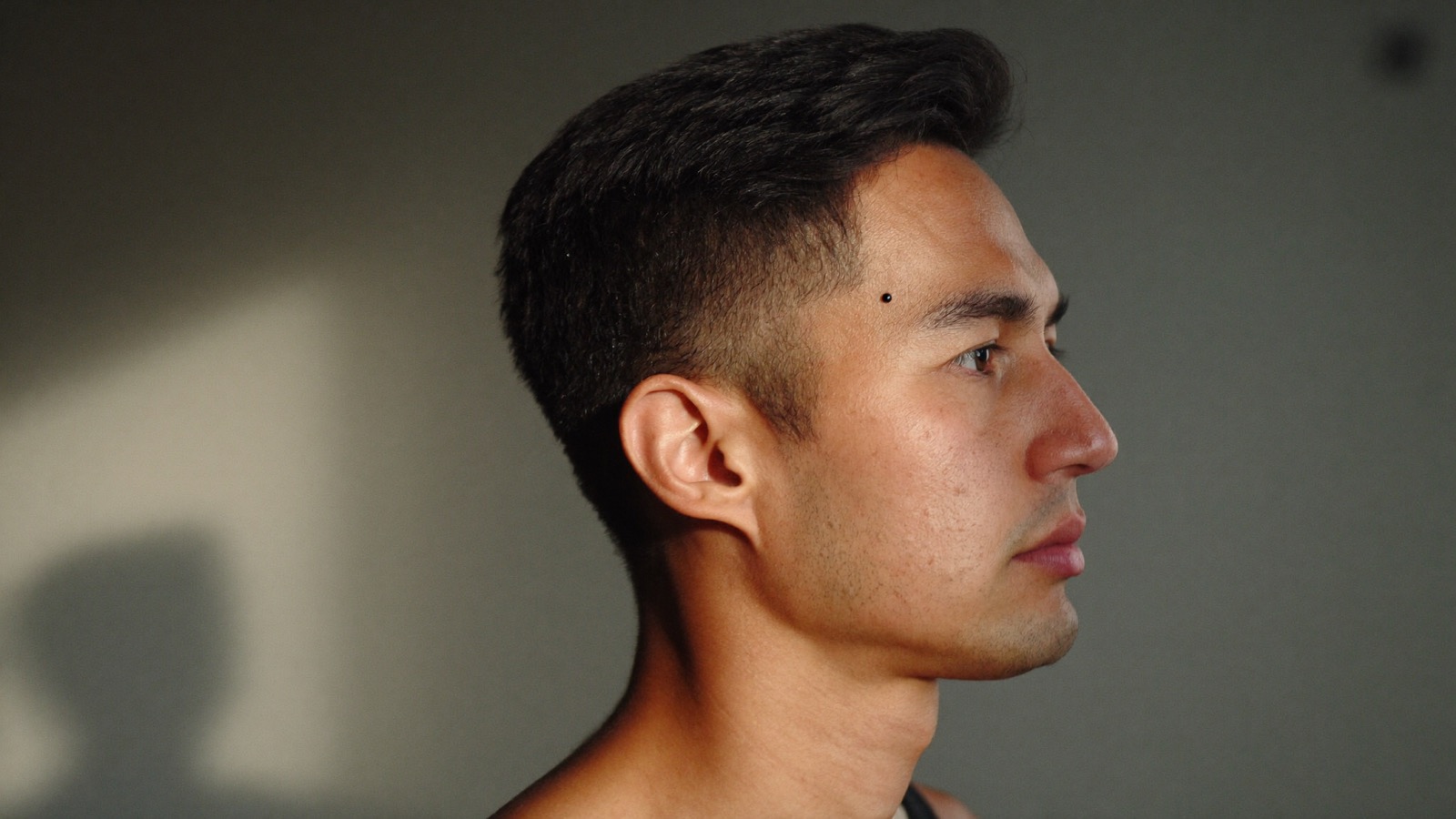
Temple point restoration rebuilds the small peaks of hair that sit just above each sideburn, in front of the ear. These points close the gap between the sideburn and the hairline and give the side of the face its frame. Restoring them uses very fine, single-hair grafts placed almost flat against the skin, which makes it one of the most delicate parts of a transplant. At our Melville clinic, temple work is planned as part of FUE hair transplant on Long Island.
Most people never think about their temple points until they are gone. Then a side photo or a fresh haircut shows an open, hollow look at the side of the head that seems to age the face. This guide explains what temple points are, why they recede, why placement is so exacting and who tends to benefit most from restoring them.
Quick answer: temple points are the small peaks of hair above the sideburns. Restoring them frames the face and softens a hollow look at the sides. The work needs fine single-hair grafts set at a very flat angle in the right direction, usually a few hundred grafts per side.
What Temple Points Are and Why They Recede
Temple points are the forward-pointing triangles of hair between the sideburn and the main hairline, sometimes called temporal peaks. In a full head of hair, they reach forward toward the outer corner of the eye and link the sideburns smoothly to the hair above.
They recede for several reasons. In male pattern hair loss, they often thin alongside the temporal corners as the hairline moves back on the Norwood scale. Age alone can soften and shorten them in both men and women. Tight hairstyles worn for years can pull hair out at the sides, and earlier transplants sometimes left the temple points untouched, so the new front looks disconnected from the sides.
The effect is subtle but real. Without the points, the face can look longer and the forehead wider at the sides, which many people describe as looking more tired or older than they feel. Your hairline shape, covered in our guide to hairline design for your face shape, works together with the temple points to frame the face.
Why the Angle Is So Critical Here
The angle is critical because temple hair lies almost flat against the skin and changes direction over a very small area. Near the sideburn, hairs point down and back toward the ear; toward the tip, they turn forward toward the eye. Grafts must follow that pattern closely.
A graft set even slightly too upright stands away from the skin and catches the light, which is what makes some temple work look stuck on. That is why temple restoration uses single-hair grafts, often chosen from finer donor hair, and very small recipient sites made at a shallow angle. It is slow, precise work, and it benefits from a team that adjusts each site individually. Our article on a natural looking hair transplant explains why angle and direction matter across the whole front.
Temple Restoration vs Frontal Hairline Work
Temple restoration and frontal hairline work are planned together but differ in almost every practical detail. The table below compares them.
| Feature | Temple points | Frontal hairline |
| Main job | Frame the side of the face | Set the front edge and face shape |
| Hair direction | Down and back, turning forward at the tip | Mostly forward, fanning slightly outward |
| Placement angle | Very flat, close to the skin | Low, but less flat than the temples |
| Graft type | Single hairs, often finer donor hair | Single hairs at the edge, larger grafts behind |
| Typical grafts | A few hundred per side | Often 1,000 to 2,000 for the hairline zone |
| How visible mistakes are | Very visible in side views | Very visible from the front |
Typical Graft Counts
Temple point restoration usually needs a few hundred grafts per side, depending on how far the points have receded and how dense you want them. Because the area is small and single-hair grafts are used, the total is modest compared with a full hairline or crown.
When temple points are restored at the same time as the hairline or temporal corners, the counts are added together in one plan, so the whole front is balanced in a single session. Our guide to how many grafts you need shows how counts are built zone by zone.
Blending Temple Points Into the Sideburns
A restored temple point only looks natural if it flows into the sideburn below it. Sideburn hair grows downward and is often slightly coarser, while temple hair is finer and turns forward toward the eye. The lowest grafts are therefore placed to follow the sideburn's downward direction, then gradually rotate as they move up toward the tip of the point.
Density also changes along that line. The base of the point, where it meets the sideburn, can carry a little more density, while the tip thins out to a few scattered single hairs, the way natural temple points do. Many men wear short sides with a fade, which shows this area clearly, so the transition is planned with your usual haircut in mind. If you keep the sides very short, mention it at your consultation so the plan accounts for how much of the blend will be on view.
Who Is a Good Candidate
Good candidates for temple point restoration usually have a stable pattern of loss, healthy donor hair and a clear gap above the sideburns that bothers them. People who often benefit include:
- Men with receding temples and corners: restoring the points with the corners gives a more complete frame.
- People with a good front but hollow sides: temple work alone can be enough.
- Women with thinning at the temples: often from tight styles or age; our article on whether women can get hair transplants covers assessment.
- People with an earlier transplant: where the front was rebuilt but the temple points were left out.
It may be better to wait if your hair loss is still moving quickly, since the points could keep receding around new grafts. Medical treatment to protect native hair is often discussed first in that case.
Healing and Seeing the Result
The temples are in plain view, so healing is worth planning for. Small crusts usually clear in about one to two weeks, and longer hair above can soften their look in the first days. Transplanted hairs commonly shed within the first month, then regrow over the following months. Because temple hairs are fine and lie flat, the points often take most of the year to look fully natural. You can see examples of finished results in our before and after gallery.
Cost and Planning in Melville
At our Melville clinic, Dr. Val Prokurat, MD designs and reviews every temple plan, and the in-house team carries out extraction and placement. Grafts for temple work cost $3.99 to $7.99 each, so temple-only plans usually sit toward the lower end of the $4,000 to $15,000 range most cases fall into. There are no session fees, and 0% financing covers the first 12 months.
See What Your Temples Need
Come in for a free consultation at 445 Broadhollow Rd, Melville, NY 11747. We look at your temple points from the side and the front, explain whether restoring them would help and give you a written graft estimate. Phone (516) 202-7223, weekdays from 9am to 6pm.