
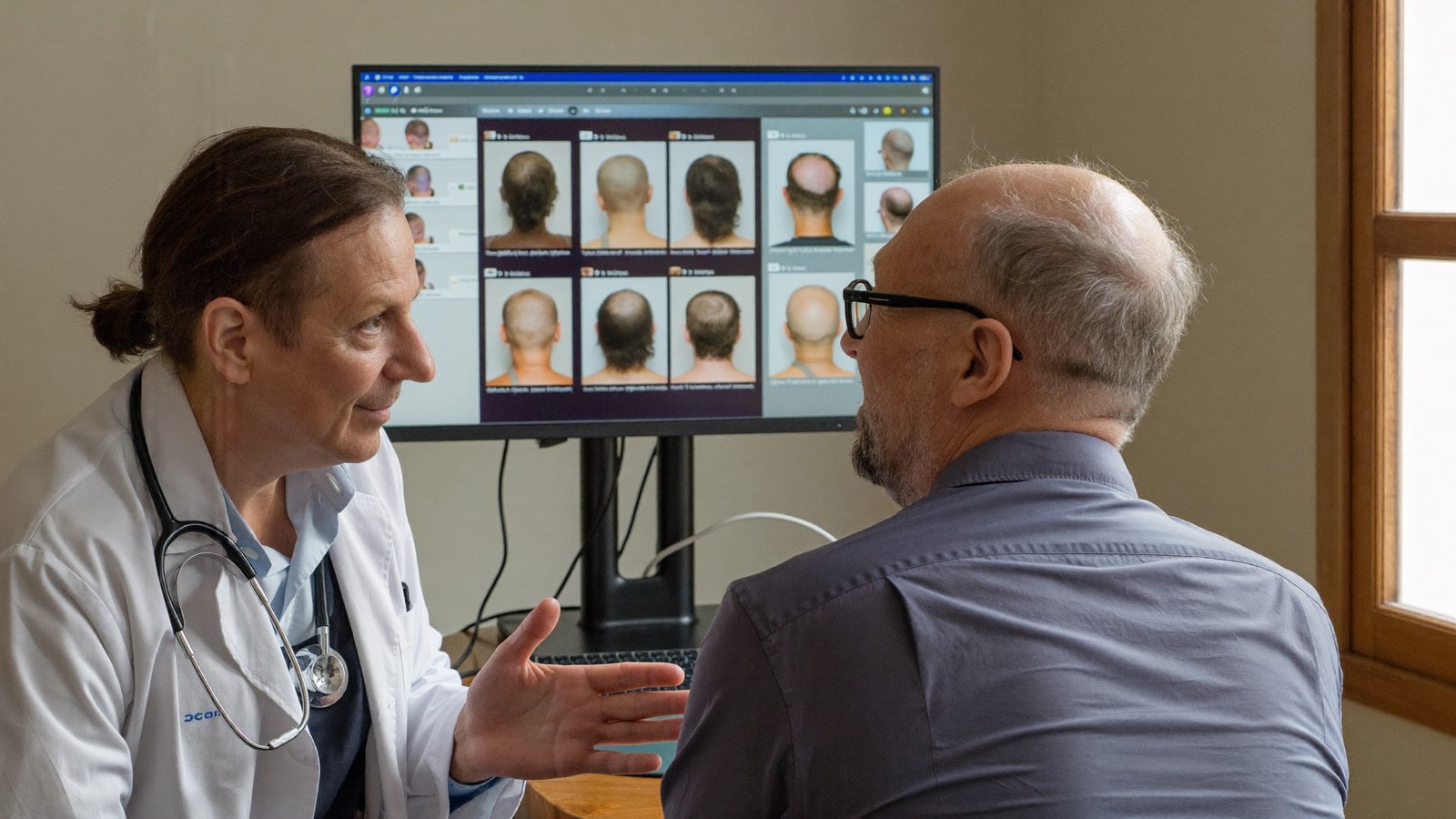
A hair transplant revision can often improve a result that did not turn out as hoped, but the right plan depends on two things above all: how long it has been since your procedure, and how much donor hair you have left. Some problems need nothing more than time, some can be refined with additional grafts, and some need older grafts camouflaged or removed first. Our hair transplant repair on Long Island page explains how corrective work is carried out; this guide helps you decide what to do next.
Being unhappy with a transplant is stressful, especially after the time and money it took. The most useful first step is not another procedure, but a calm, clear assessment of what went wrong, what can realistically change and what it would take. For the reasons results fall short in the first place, see our article on why hair transplants fail.
Quick answer: many disappointing results can be improved. Wait until at least 12 months after surgery, longer for the crown, before judging. A revision plan then depends on your remaining donor hair and on whether the issue is density, design, direction or old-style grafts. Options range from adding grafts to camouflage to removing and replacing grafts.
How Long to Wait Before Deciding
You should usually wait at least 12 months after surgery, and up to 18 months for the crown, before deciding a result needs revision. Transplanted hair sheds in the first weeks, rests, and grows back slowly, so a result that looks thin at four or six months can still improve a great deal.
There are exceptions. Problems that will not change with time, such as a hairline placed far too low, grafts pointing in clearly the wrong direction or visible old plugs, can be assessed earlier, even if any work still waits for the scalp to settle. If you are unsure where you are in the growth curve, our recovery timeline sets out what is normal at each stage.
How the Donor Supply Is Re-Checked
The donor area decides what a revision can achieve, because grafts used in the first procedure cannot be replaced. Before any plan is made, the back and sides of your scalp are examined closely to see how many follicles remain, how evenly earlier extraction was spread and whether any scarring limits further harvesting.
If the donor area was heavily used, a revision may need to be more targeted, focusing on the zone that makes the biggest difference to your appearance rather than on full coverage everywhere. Our guide to the donor area explains why the supply is finite and how it is protected.
Common Problems a Revision Addresses
Most revisions deal with one or more of a short list of problems:
- Low density: the area grew, but too thinly to look full.
- An unnatural hairline: too low, too straight, too sharp or the wrong shape for your face and age.
- Wrong direction or angle: hairs that stick up or point forward instead of following natural flow.
- Old-style plugs: large round grafts that look tufted, often from procedures decades ago.
- Visible donor scarring: a wide strip scar or over-harvested patches at the back.
- Gaps from ongoing loss: native hair around the transplant has thinned, leaving the grafts isolated.
Options: Refine, Camouflage, Remove and Replace
Revision options fall into three broad groups, often combined in one plan.
Refine
Refinement adds new grafts to improve what is already there: building density, softening a harsh hairline with single-hair grafts in front of it, or filling gaps left by ongoing loss. It is the most common kind of revision and works when the existing grafts are broadly in the right place.
Camouflage
Camouflage hides problems without removing anything. Fine grafts can be placed around large older grafts to blend them, grafts can be added into an old strip scar to break up the line, and some people add scalp micropigmentation from a specialist provider to reduce contrast in thin or scarred areas. Camouflage is often enough when the problems are mild.
Remove and replace
When grafts are badly placed, such as a hairline set far too low or plugs that cannot be blended, some may need to be removed, often using FUE so they can be divided and reused where they look natural. This is the most involved option and usually happens in stages.
Problem vs Usual Approach
The table below matches common problems with the approach most often considered. Your own plan depends on your donor hair and goals.
| Problem | Usual approach | Typical number of stages |
| Low density, good placement | Refine with additional grafts | One |
| Harsh or straight hairline | Soften with single-hair grafts in front | One |
| Hairs at the wrong angle | Camouflage around them, or remove and replace the worst | One or two |
| Old-style plugs | Blend with fine grafts, or remove and reuse | Often two |
| Hairline set too low | Remove and replace in stages | Two or more |
| Wide donor scar | Grafts into the scar; some add specialist micropigmentation | One |
What a Realistic Revision Looks Like
A realistic revision makes your hair look natural at normal viewing distance; it does not usually recreate the density you had before hair loss began. The amount of improvement depends on how much donor hair is left, how your skin has healed and how extensive the earlier work was.
Revisions also take patience. New grafts follow the same growth cycle as any transplant, and staged plans can take more than a year from start to finish. A good plan explains each stage, what it is expected to achieve and when it can be judged. Our article on a natural looking hair transplant explains the design principles that revisions aim to restore.
Should You Go Back to the Original Clinic?
Going back to the clinic that did the first procedure is a reasonable first step, especially if it offers follow-up or correction within its own policies. It has your records and knows exactly what was done. Some people prefer a second opinion, either because trust has been lost or because they want an independent view of what is possible.
Either way, the same questions apply: what is the problem, how much donor hair remains, what will each stage achieve and how will progress be judged. A clinic that answers those clearly and in writing is easier to rely on than one that promises a dramatic fix in a single session.
What to Bring to a Revision Consultation
Bringing the right information makes a revision consultation far more useful:
- Records from your earlier procedure: the date, technique and graft count if you have them.
- Photos: before the procedure, during healing and now, ideally in similar light.
- Your treatment history: any medication or other hair loss treatment since.
- Your main concern: what bothers you most, in your own words.
- Your questions: written down, so none are missed.
Revision plans in Melville are reviewed and directed by Dr. Val Prokurat, MD, while extraction and placement are handled by our in-house team. You can contact us to book a free consultation. Corrective grafts cost the same as any transplant: $3.99 to $7.99 each. Most cases total $4,000 to $15,000, with no session fees and financing at 0% for the first year.
Get an Honest Review of Your Result
Bring your records and photos to a free consultation at 445 Broadhollow Rd in Melville, where we review your result, check the donor hair you have left and set out realistic options in writing. Phone (516) 202-7223 on weekdays between 9am and 6pm.