
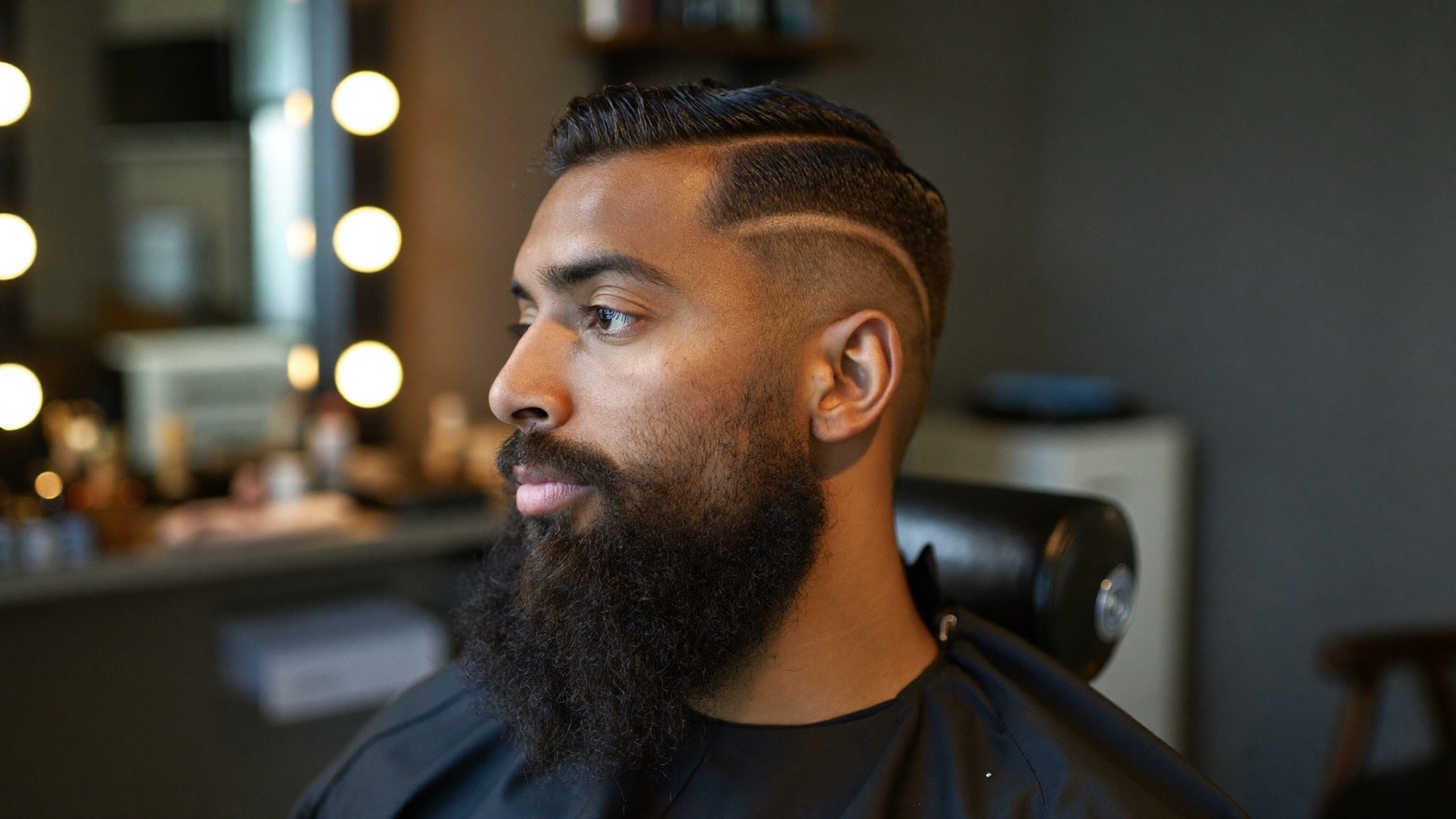
How does a beard transplant work? Hair follicles are taken one at a time from the back of your scalp and set into small openings across the cheeks, chin, mustache or sideburns, angled to match the way facial hair grows. The transplanted hairs usually shed within a few weeks, and new growth starts at around three months. If you are weighing the treatment itself, our page on beard transplants at our Long Island clinic covers candidacy and pricing. This guide follows the patient journey instead: how the beard is designed, how many grafts each area tends to take, what happens on the day, how the first two weeks feel and when the result settles.
Facial hair is less forgiving than scalp hair. It lies flat, it changes direction every few centimeters, and it is seen in close conversation under bright light. A beard that looks natural depends far more on planning and placement than on how many grafts are moved, which is why most of this article is about decisions made before the first follicle is touched.
Quick Answer: Scalp Grafts Placed One by One Into the Beard
A beard transplant moves individual follicular units from a stable donor zone, usually the back and sides of the scalp, into the parts of the face where hair is sparse or missing. Each graft is placed at a shallow angle and in the local direction of growth, so the new hairs lie flat and blend with the beard you already have. The procedure runs under local anesthetic, you go home the same day, and visible regrowth begins at about month three, with the fuller result taking most of a year.
- Where the hair comes from: the donor zone at the back of the scalp, where follicles are resistant to the hormone-driven thinning that affects the top of the head.
- How it is removed: follicular unit extraction (FUE), which takes grafts individually with a fine punch and leaves small dot scars rather than a line.
- How it is placed: mostly single-hair grafts, set into tiny incisions that follow the direction of each zone of the face.
- When it grows: shedding in the first weeks, early growth from around month three, steady thickening through months six to twelve.
Key point: A beard transplant does not change how your own facial hair grows. It adds permanent follicles to the gaps, and those follicles keep the growth habits of the scalp hair they came from.
Designing the Beard: Cheek Line, Mustache, Goatee and Sideburns
The design is settled before surgery, at consultation, and it decides most of how natural the result looks. The team maps the areas to fill, the outline of each one and how dense each should be, working from the hair you already grow rather than from a template.
The cheek line
The upper cheek border is the line people notice first. A cheek line drawn too low leaves a bare band under the cheekbone; one drawn too high and too straight looks shaved on. Most plans use a soft, slightly irregular upper border that thins gradually into bare skin. Density is usually lighter at the very top and builds toward the jaw, which mirrors how a naturally full beard behaves.
The mustache
The mustache is small but grows in several directions at once. Hairs near the center point down, hairs toward the corners of the mouth fan outward, and the edge along the lip needs fine single hairs so the line is not blunt. Gaps under the nose and at the corners are common reasons to treat this area alone.
The goatee and chin
Many men have a strong mustache and jaw but a sparse chin, or a bare patch between the lower lip and the chin. Filling this area connects the mustache to the beard and gives a goatee shape that holds even when the rest of the beard is kept short. Direction here changes quickly, from downward under the lip to forward and outward across the chin.
The sideburns and jawline
Sideburns link the scalp hair to the beard. If they stop short, a full beard can look as if it floats on the face. Extending the sideburns and filling the jaw angle restores that link. Along the lower jaw and neck, hair points downward and slightly back, and the neckline itself is usually left to grooming rather than surgery.
Your preferences shape all of this. Some men want a full beard, others a defined goatee or simply a mustache that fills in evenly. Saying how you actually wear your facial hair, including how short you trim it, helps the team choose which zones matter most and how to use a limited donor supply.
Table: Beard Area vs. Typical Graft Range
Graft numbers for facial hair vary widely with the size of the gap, how much hair is already there and the density you want. The ranges below are typical planning figures, not quotes; your own count is set at assessment.
| Area | Typical graft range | Main design concern |
| Mustache | About 250 to 500 | Fan-shaped direction, soft lip edge |
| Goatee and chin | About 300 to 700 | Connecting mustache and chin, rapid direction changes |
| Sideburns (both sides) | About 150 to 400 | Joining scalp hair to the beard |
| Cheeks (both sides) | About 500 to 1,500 | Soft upper border, flat angle |
| Jawline and lower beard | About 300 to 800 | Downward direction, even density |
| Patch or scar repair | About 100 to 400 | Matching the surrounding hair |
| Full beard (combined areas) | About 1,500 to 3,500 | Donor supply and session length |
Two practical points follow from these numbers. First, most single-area cases are modest in size, so a mustache or goatee can often be completed in a shorter session. Second, a full beard draws on the same donor zone that a future scalp procedure might need. If your scalp hair is thinning too, the plan should account for both. Our guide to how much hair the donor area can supply explains how that reserve is measured and protected.
Some patients with fine scalp hair or a limited donor area also ask whether hair under the chin can be used. It can occasionally serve as a donor for small repairs, but the back of the scalp remains the usual source because its hair caliber and permanence are predictable.
The Procedure Day
On the day, the session runs as a single outpatient visit, usually somewhere between two and six hours depending on how many grafts are planned. You arrive with the design already agreed, the outline is marked on your face, and you can review it in front of you before anything begins. Dr. Prokurat reviews the final plan and the in-house team carries out extraction and placement following it.
Preparing the donor area
The donor zone at the back of the scalp is trimmed short so each follicle can be seen and removed cleanly. In smaller cases a narrow band can be trimmed and hidden under longer hair above it. Local anesthetic numbs the area; after the first injections most people feel pressure rather than pain.
Extraction
Grafts are removed one at a time using FUE. For facial work the team looks for fine, single-hair units that will sit well on the face, and stores each graft in a chilled solution until it is placed. You lie face down or on your side during this stage and can rest, listen to music or watch something. More detail on the extraction method itself is on our FUE hair transplant page.
Placement
The face is then numbed and tiny recipient incisions are made at a very shallow angle, following the direction of growth in each zone. Each graft is set into its incision so the hair lies almost flat against the skin. This is the slowest and most detailed part of the day, because every change in direction across the cheek, chin and mustache has to be followed graft by graft.
You go home the same day with written aftercare instructions, a contact number for questions and follow-up arranged. Arranging a ride home is sensible after a long session, since your face and scalp will be numb for a few hours.
The First Two Weeks: Redness, Crusts and When to Shave
The first two weeks are the visible part of recovery: small crusts form around each graft, the face looks pink, and you should not shave or trim the treated areas until the team tells you it is safe, which is usually after about ten days to two weeks.
Days 1 to 3
Mild swelling around the cheeks and chin is common, along with tightness in the donor area. You sleep with your head raised and avoid touching or rubbing the face. Gentle rinsing follows the written instructions you are given; there is no scrubbing.
Days 4 to 7
Tiny crusts sit around each new hair. They are part of normal healing and fall away on their own with gentle washing, usually within about a week. Picking them off risks pulling the graft before it has anchored. Most people with desk jobs return to work within a few days, although the face can still look slightly red. Our article on how much time off work to plan covers the timing for different kinds of jobs.
Days 8 to 14
Redness fades steadily, and by the end of the second week the face generally looks close to normal from conversational distance. Once you are cleared to shave, use a clean electric trimmer at first rather than a blade, and keep pressure light over the grafted zones. Strenuous exercise, saunas and swimming wait until the team confirms the skin has settled.
Key point: The grafts are secure in the skin after roughly ten days, but the hair shafts above them often fall out over the following weeks. That shedding is expected and does not mean the follicles were lost.
Growth Timeline and Final Density
Transplanted beard hair follows a slow, predictable timeline: shedding in the first one to two months, early growth from around month three, and a full result between nine and twelve months. Knowing the stages helps you judge progress without worrying at each step.
- Weeks 2 to 8: most transplanted hairs shed. The follicle stays in the skin and enters a resting phase. The beard may look much as it did before surgery.
- Months 3 to 4: fine new hairs begin to appear, often unevenly. Some areas wake up earlier than others.
- Months 5 to 8: hairs thicken and darken, and coverage becomes clearly visible. Most men can start styling and trimming the beard as normal.
- Months 9 to 12: the result matures. This is the point at which density is judged and a small top-up is discussed if one area is lighter than planned.
The shedding phase is the same process that follows a scalp transplant, and our article on why transplanted hair sheds and when regrowth starts explains the biology in more detail.
Will it grow like a beard or like scalp hair?
Transplanted follicles keep many of the traits of the scalp hair they came from. They can grow longer than native beard hair if left untrimmed, and they may be slightly softer or straighter. Once the beard is trimmed to a regular length, the difference is usually hard to see. Matching graft caliber to your facial hair at the design stage helps keep the blend close.
What affects final density
Density depends on how many grafts were placed per area, how well the skin heals, the caliber and color of your donor hair, and how closely it matches your existing beard. Smoking slows wound healing, so stopping well before and after surgery helps. A single session suits most cases, but a second, smaller session for refinement is reasonable if you want more density in one zone once the first result has matured.
Who Is a Good Candidate for a Beard Transplant
Good candidates have a healthy donor zone at the back of the scalp, realistic goals for density and a stable pattern of facial hair. Common reasons for treatment include patchy cheeks, a gap between the mustache and goatee, sideburns that stop short and scars from injury, surgery or acne where hair no longer grows.
A few situations call for more caution. Men with significant scalp thinning may need to save donor hair for the scalp. Active skin conditions on the face, such as untreated inflammation or infection, should be managed first. Patchy beard loss that comes and goes, sometimes caused by alopecia areata, needs a medical diagnosis before surgery is discussed, because grafts placed into an active area of that condition may not hold. Organizations such as the American Academy of Dermatology and the International Society of Hair Restoration Surgery both stress a proper diagnosis before any hair restoration procedure.
If you are unsure how many grafts your face would need, the general principles in our guide to estimating graft numbers apply to facial work too, with smaller totals and more single-hair units.
Getting a Beard Plan Built for Your Face on Long Island
The most useful first step is an assessment of both your donor hair and the areas you want to fill. During a free consultation at 445 Broadhollow Rd on Route 110 in Melville, the team looks at your facial growth pattern, your scalp donor density and the style you want to wear. Dr. Prokurat reviews the proposed design, and you leave with a written graft estimate.
The clinic is close to the Long Island Expressway and the Northern State Parkway, so patients from across Nassau and Suffolk reach us easily. Appointments run Monday to Friday, 9am to 6pm. Call (516) 202-7223 or use the contact form, and bring a few photos of how you like to wear your beard; they make the design conversation faster and more specific.
Medically reviewed by Dr. Val Prokurat, MD. Dr. Prokurat is a physician with advanced training in minimally invasive techniques who reviews and oversees every treatment plan at Nova Medical Hair Transplant Long Island, 445 Broadhollow Rd in Melville. This article is for general education and is not a substitute for an in-person medical assessment. Individual results vary. Read more about Dr. Prokurat.
Plan the Beard You Want to Grow
Have your donor hair and facial growth pattern assessed, and leave with a written graft estimate for the areas you want to fill. Free assessments at our Melville clinic on Route 110.