
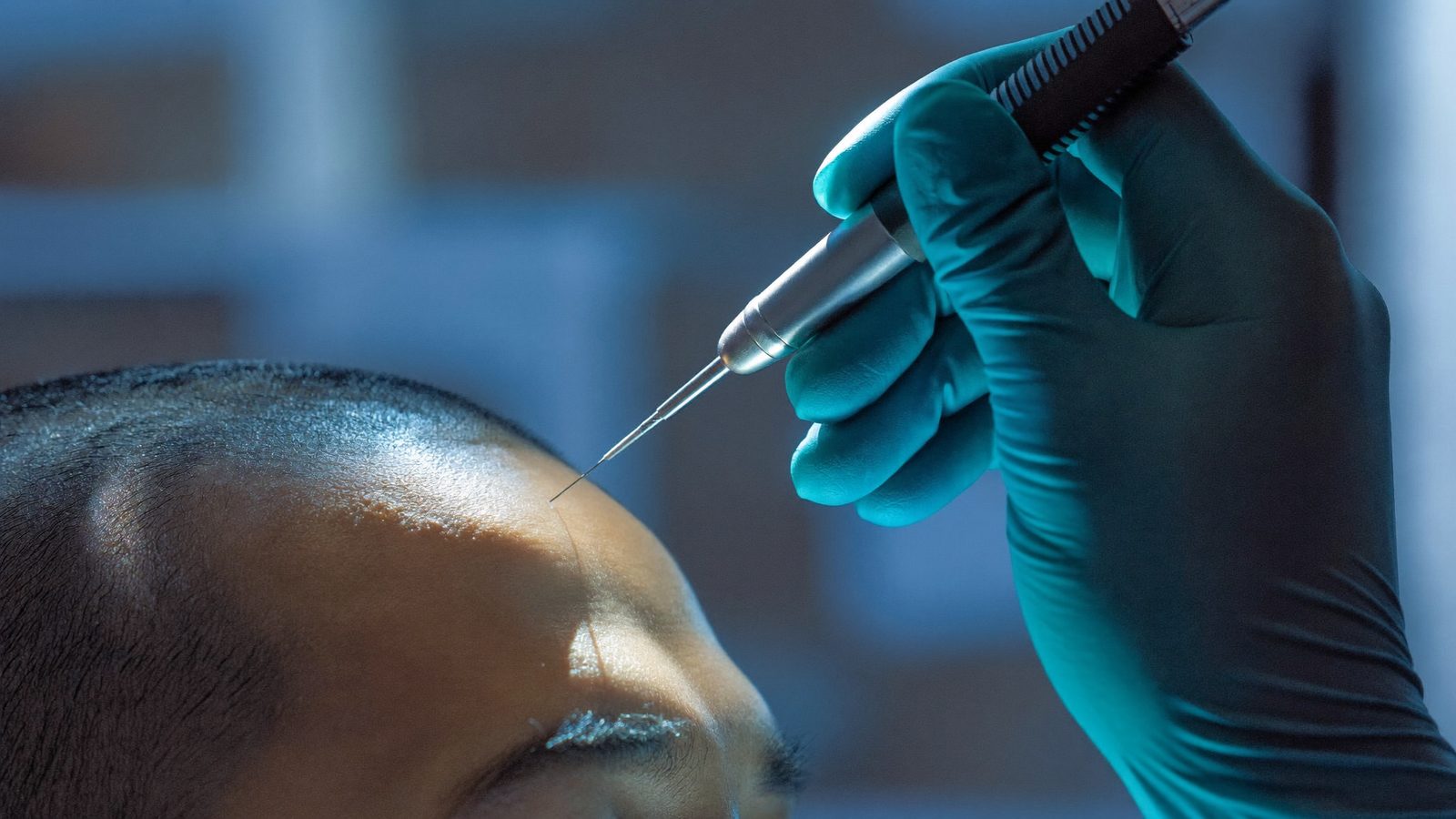
The DHI vs FUE debate is smaller than most clinic marketing makes it sound. DHI (direct hair implantation) is not a separate kind of transplant. It is a variation of FUE in which the grafts are extracted exactly the same way, one follicular unit at a time, and then loaded into a slim implanter pen that opens the skin and places the graft in a single motion. Classic FUE places grafts by hand with forceps into tiny sites that were made in advance. If you want the clinical details of how we run the pen technique in Melville, our DHI hair transplant page for Long Island patients walks through the full procedure day.
This article answers a narrower question: what does the pen actually change for you, and what stays exactly the same? We compare the two placement methods on the points that matter in a real plan, namely control over angle and depth, how many grafts fit in one day, whether you need to shave, how long the session takes and which hair loss patterns suit each approach. We also cover the limits of DHI, because the pen is a tool with strengths and trade-offs, not an upgrade that suits every scalp.
Quick Answer: DHI Is FUE With a Different Final Step
DHI belongs to the FUE family: extraction is identical, and the only real difference is that grafts go in with an implanter pen instead of into pre-made sites. Everything that determines how much hair you can move, how the donor area heals and how many grafts you have for life is decided at the extraction stage, and that stage does not change.
Think of an FUE transplant as three stages:
- Harvest. Individual follicular units are removed from the back and sides of the scalp with a small round punch. On Long Island our team uses manual FUE with motorized handheld tools, not a robot.
- Holding. Grafts are sorted by hair count and kept chilled and hydrated until placement, as described in the Nova Medical FUE Protocol.
- Placement. This is where the two methods split. In classic FUE, the team makes all the recipient sites first, then fills them with forceps. In DHI, each graft is loaded into a hollow needle inside a pen, and the pen creates the opening and deposits the graft in one stroke.
So when someone asks whether DHI is "better than FUE," the honest reply is that the comparison is really between two ways of finishing the same operation. The hair that grows is the same permanent donor hair either way. Growth follows the same calendar either way: shedding at 2 to 6 weeks, new growth from about month 3 to 4, and a final result around 12 to 18 months.
Key point: The pen does not create more grafts, raise graft survival on its own or make donor hair last longer. It changes how the recipient area is handled. Your donor supply, often estimated at roughly 5,000 to 7,000 grafts over a lifetime depending on density, is the same whichever placement method you choose.
How Implantation Differs Step by Step
Implantation differs in the order of events: classic FUE makes every site first and fills them later, while DHI makes and fills each site at the same moment. That change in sequence is the source of nearly every advantage and disadvantage attributed to DHI.
Classic FUE placement
After harvesting, the team maps the recipient zone and creates hundreds or thousands of small incisions with a fine steel blade or needle. The angle, direction and depth of each site are set at this stage, so the hairline design is effectively drawn in incisions before a single graft goes in. Then placers pick up each graft with fine forceps and slide it into its waiting site. Two or more team members can place at the same time, which keeps the day moving on larger cases. (The choice of blade material for these sites is its own topic; our article on sapphire versus steel recipient-site tools explains what that choice changes.)
DHI placement
With DHI, there is no separate site-making stage. A technician loads one graft into the hollow needle of an implanter pen, often called a Choi implanter pen after the design it comes from. The pen is positioned at the planned angle and depth, the needle enters the skin, and a plunger pushes the graft out as the needle withdraws. Several pens are usually loaded in rotation, so one person loads while another implants. Pens come in different needle diameters, and the team picks the size to match single-hair, double-hair and larger units.
What that sequence means in practice
- Time out of the body. Because each graft goes in as soon as it is loaded, the gap between handling and placement for that individual graft can be short. In classic FUE, careful chilled storage keeps grafts healthy while sites are made, so this is a difference in workflow rather than a proven difference in outcome.
- Handling. Forceps hold the graft directly. The pen holds it inside a needle. Both require skilled hands, and both can damage grafts if done carelessly.
- Design control. In classic FUE, the design lives in the sites. In DHI, the design is built graft by graft, with angle and direction set fresh for each one.
- Bleeding and visibility. Pre-made sites can bleed a little and make it harder to see where existing hairs are. Placing one graft at a time can make it easier to work between native hairs without disturbing them.
Where DHI Helps: Hairline Detail, Unshaven Areas and Density Packing
DHI is most useful when the work is detailed and the area is limited: refining a hairline, adding density between existing hairs, or treating a zone you would rather not shave. In those situations, building the result one graft at a time gives the team fine control where it shows the most.
Hairline refinement
The front hairline is the part of a transplant people notice first. A natural hairline is irregular, with single hairs at the front edge, slightly larger units behind them and a gradual change in angle from the temples toward the center. With the pen, each graft's angle and direction can be set as it is placed, which suits the small, careful adjustments a soft hairline needs. Classic FUE can produce an equally natural hairline in experienced hands; the pen simply offers a different way to get there.
Working between existing hair
Many patients we see in Melville are not bald in the area they want treated. They are thinning, with plenty of native hair still present. Making hundreds of sites in advance in that kind of scalp risks cutting into existing follicles you want to keep. Placing grafts one by one with a pen lets the team see the native hairs at each step and slot new grafts into the gaps.
Treating without a full shave
For small and medium cases, DHI is often chosen because the recipient area may not need shaving, or may only need a trim. The surrounding hair can then hide the work during the first weeks. This is a real advantage for people who cannot take much time away from a public-facing job. Be aware that the donor area still needs to be trimmed short where grafts are taken, because extraction is the same FUE step either way. Partial-shave or patch-harvest options exist, but they limit how many grafts can be taken in one day.
Targeted density work
When a previous transplant left an area looking slightly see-through, or a hairline needs a few hundred grafts of reinforcement, DHI is a sensible fit. The session is small, the area is defined and the priority is precise placement rather than covering ground quickly.
Where Classic FUE Is More Practical: Large Sessions and the Crown
Classic FUE placement is usually the more practical choice for large sessions and for wide areas such as the crown, because pre-made sites let several team members place grafts at once and keep long days efficient. Speed matters here not for convenience but because a very long day is harder on both the patient and the grafts.
Session size
Every graft in a DHI case has to be loaded into a pen individually, and pens are handled by a limited number of people. That makes very large single-day sessions slower with the pen. For someone at Norwood 4 or 5 who needs a substantial graft count spread across the front and mid-scalp, classic FUE placement often allows the plan to be completed in one day with less strain. Our guide to working out how many grafts you need shows the typical ranges by zone.
The crown
The crown, or vertex, grows in a whorl, with hair direction changing all the way around a central point. It is also a wide, often fully bald area. Classic FUE lets the team lay out the entire swirl pattern in sites first, check it as a whole, and then fill it efficiently. DHI can be used in the crown, but for a large bald vertex the pen offers less benefit and takes longer.
Fully bald areas
Where there is no native hair to protect, the main advantage of placing one graft at a time between existing hairs disappears. A bald frontal zone can be planned and filled very precisely with pre-made sites.
Mixed plans
Many plans do not have to choose one or the other for the whole scalp. A common approach is classic FUE placement for the larger body of the work, with pen placement reserved for the first rows of the hairline or for zones with dense native hair. Your plan is written around your scalp, not around a technique name.
DHI vs. FUE vs. Sapphire FUE at a Glance
The three names you will see online differ only in the placement stage: classic FUE uses steel-made sites and forceps, DHI uses an implanter pen, and sapphire FUE uses sapphire blades to make the sites. The table below compares them on the practical points. Note that sapphire FUE is not offered at our Long Island clinic; it is included because patients often ask how it fits.
| Factor | Classic FUE | DHI (implanter pen) | Sapphire FUE |
| Extraction method | Individual punch excision, 0.8 to 1.0 mm range typical | Identical to FUE | Identical to FUE |
| How recipient sites are made | All sites made first with fine steel blades or needles | No separate stage; the pen needle opens each site as it implants | All sites made first with sapphire blades |
| Graft placement tool | Forceps | Implanter pen | Forceps |
| Typical session fit | Small to large, including 2,500+ grafts in one day | Small to medium, detailed zones | Small to large |
| Recipient shaving | Usually shaved or trimmed short | Often possible unshaven for limited areas | Usually shaved or trimmed short |
| Working between native hair | Good with careful site planning | Very good, one graft at a time | Good with careful site planning |
| Session speed | Faster for large cases; several placers can work at once | Slower per graft; limited by pen loading | Similar to classic FUE |
| Donor area result | Small dot scars spread across the donor zone | Same as FUE | Same as FUE |
| Offered on Long Island | Yes | Yes | No |
Two lessons come out of the table. First, every row about the donor area is identical, because extraction does not change. Second, the differences sit almost entirely in the recipient area and in how the session is staffed and timed. If you want a refresher on how FUE extraction itself compares with the strip method, our guide to choosing between FUE and FUT covers that separate decision.
What the Pen Does Not Change
The implanter pen does not change your donor supply, your long-term hair loss pattern, the growth timeline or the need for an experienced team. These are the factors that shape a transplant result more than the placement tool, and they are worth keeping in view whenever a technique is presented as a breakthrough.
- Donor limits. Grafts are extracted with the same punch technique, so the number you can safely take is the same. Overharvesting is a risk in any FUE-based method.
- Ongoing hair loss. Transplanted hair comes from a zone that is genetically resistant to pattern loss, but the native hair around it can keep thinning. Medical therapy such as FDA-approved finasteride and minoxidil is a separate conversation to have with your physician.
- Extraction skill. How cleanly grafts are cut and lifted matters for both methods. If you are curious how the extraction tool itself compares, our article on manual versus robotic FUE extraction looks at that question. Robotic FUE is not offered at our Long Island clinic.
- Healing in the recipient area. Both methods produce small scabs that typically clear within 7 to 10 days. A pen does not make the skin heal on a different biological schedule.
- Who oversees the plan. At our clinic, every treatment plan is reviewed and overseen by Dr. Val Prokurat, MD, and the extraction and placement are carried out by our permanent in-house team of experienced technicians, whichever placement method is used.
Professional bodies such as the International Society of Hair Restoration Surgery (ISHRS) emphasize physician judgment and careful planning over the brand name of any one device. That matches what we see in consultations: the patients who are happiest with their results usually chose a plan that fit their hair, not a technique name.
Speed, Comfort and Recovery Compared
Recovery after DHI and classic FUE is broadly similar, because the donor area heals the same way and both methods leave small recipient-area scabs. The differences patients notice are mostly about the length of the day and how visible the work is afterward.
The procedure day
Both methods use local anesthesia, and most patients are awake and relaxed through the day. A DHI session of a given graft count often runs longer than a classic FUE session of the same size, because placement happens one graft at a time with pens. For a small hairline case, that difference may be minor. For a large case, it can add meaningful time.
The first two weeks
If the recipient area was left unshaven in a DHI case, the surrounding hair can hide much of the early redness and scabbing. That is the main reason some people feel they recovered faster, even though healing itself follows a similar pattern. The donor area looks the same in both methods, so plan for a short trimmed zone at the back and sides. Our recovery guidance for Long Island patients sets out the aftercare we give for both.
Comfort
Most patients describe mild tenderness for a few days in the donor area, which is common to both. Some report the recipient area feels less disturbed after pen placement in a small case, but experiences vary and we would not promise one method feels easier than the other.
Choosing at Your Consultation
The right choice comes from your assessment, not from a technique preference you bring in the door. At a free consultation in Melville, we look at your pattern, your native hair density, your donor supply and your daily life, and then recommend classic FUE placement, DHI, or a combination.
Situations where we often lean toward DHI
- A hairline lowering or refinement of a few hundred to roughly 1,500 grafts
- Thinning areas with a lot of native hair that should not be disturbed
- A strong preference to avoid shaving the recipient zone
- Small density top-ups or touch-ups after an earlier transplant
Situations where classic FUE placement usually makes more sense
- Larger cases, especially 2,500 grafts or more in one day
- A wide, mostly bald crown
- Advanced Norwood stages where coverage across a big area is the goal
- Cases where keeping the day to a reasonable length is a priority
Who may not be a good candidate for either
A transplant of any kind may not be the right step yet if your hair loss is very early and changing fast, if your donor area is weak or already depleted, or if a medical cause of shedding has not been ruled out. The American Academy of Dermatology notes that many forms of hair loss have causes that need diagnosis before treatment. In those situations, we would rather talk you through medical options and timing than book a procedure. You can read how our FUE hair transplant service is planned when the timing is right.
Key point: Ask any clinic which steps of your procedure the pen is actually used for. If the answer is "the whole thing" on a large case, ask how long the day will be and how many people will be loading and placing grafts.
Cost and Planning on Long Island
The placement method is one factor in your quote, but graft count is the main driver of cost. Our published pricing runs from $3.99 to $7.99 per graft depending on technique and case, and most procedures total $4,000 to $15,000. There are no session fees, and 0% interest financing is available for the first 12 months. You receive a written quote after your free assessment, so you can compare a DHI plan and a classic FUE plan with real numbers side by side.
Our clinic is at 445 Broadhollow Rd on Route 110 in Melville, a short drive from the Long Island Expressway, which makes it a practical stop for patients from across Nassau and Suffolk counties. Consultations run Monday to Friday, 9am to 6pm. During the visit we examine your scalp under magnification, estimate your donor capacity, mark the zones that need work and explain which placement approach fits each zone. You leave with a plan and a quote, and there is no pressure to decide on the day.
The Short Version Before You Book
DHI and classic FUE take your grafts out of the donor area in exactly the same way. The pen changes how they go back in: one at a time, with each opening made at the moment of placement. That helps with fine hairline work, thinning areas full of native hair and cases where you want to avoid a shave. Classic FUE placement stays more practical for large sessions, wide bald areas and the crown. Neither creates extra donor hair or speeds up the 12 to 18 month growth timeline.
The useful question is not which technique wins in general, but which one fits your scalp, your graft count and your schedule. Bring that question to a free assessment on Long Island, and we will answer it with your own measurements rather than a sales pitch.
Medically reviewed by Dr. Val Prokurat, MD. Dr. Prokurat is a physician with advanced training in minimally invasive techniques who reviews and oversees every treatment plan at Nova Medical Hair Transplant Long Island, 445 Broadhollow Rd in Melville. This article is for general education and is not a substitute for an in-person medical assessment. Individual results vary. Read more about Dr. Prokurat.
Pen or Forceps? Get a Plan Built for You
At a free assessment in Melville we map your thinning zones and donor area, then recommend DHI, classic FUE placement or a combination, with a written quote.