
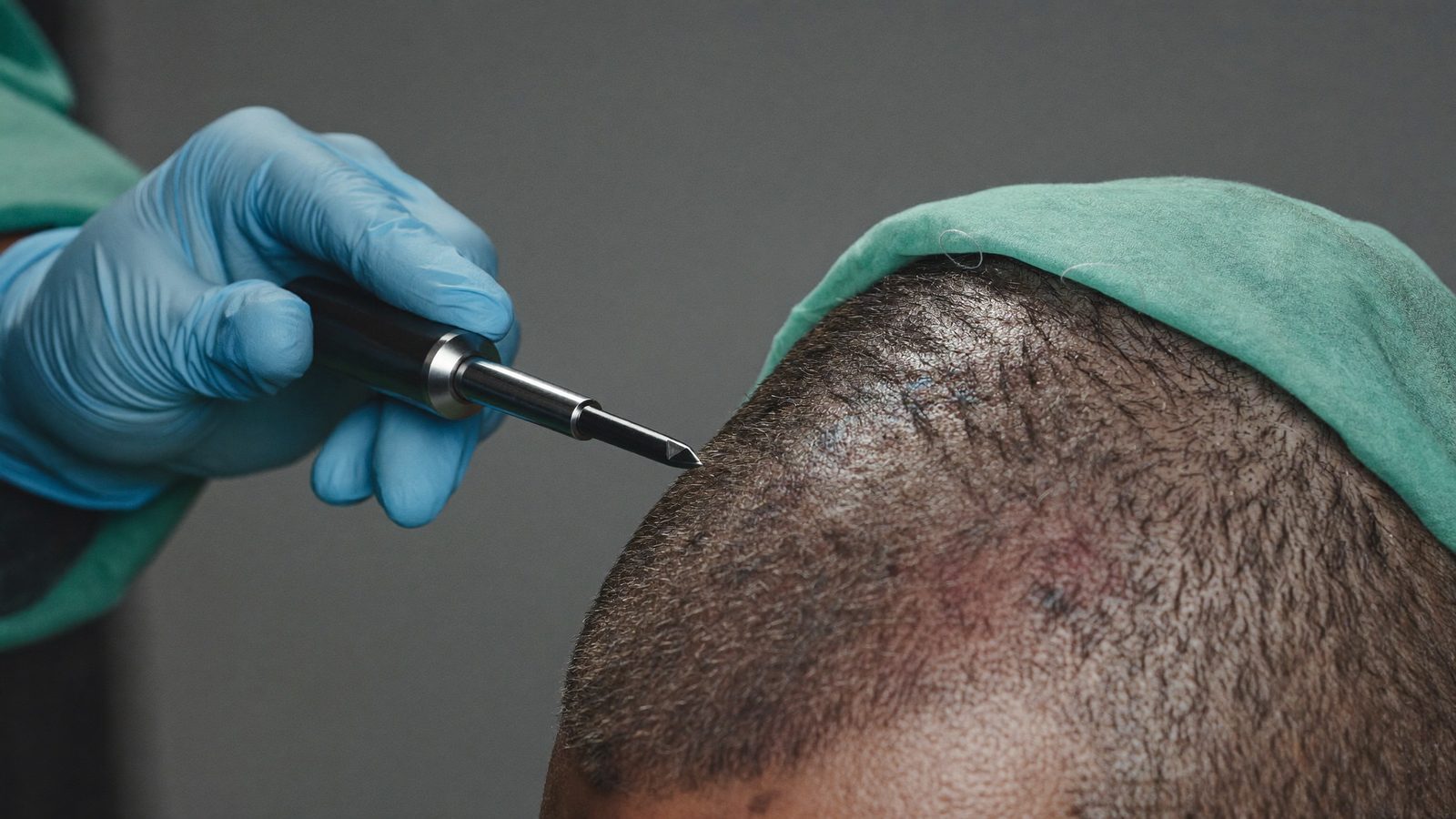
The manual FUE vs robotic FUE question is really a question about the extraction tool, not the transplant itself. All three common approaches - a hand-turned punch, a motorized handheld punch and a robotic arm - remove follicles one at a time from the donor area, and all of them can produce natural hair. Our Long Island team uses manual FUE with motorized handheld tools, and our FUE hair transplant page for Long Island patients explains the full procedure. This guide stays focused on the extraction step and what the choice of tool means for your grafts, your donor area and your final density.
Patients often arrive at a consultation in Melville having read that a robot must be more precise than a person. Sometimes that belief is reasonable, sometimes it is marketing. Below we compare the methods plainly, explain where an experienced technician's judgement changes the outcome, and describe the hair types that suit each approach. We also say where robotic systems have genuine strengths, because a fair comparison helps you ask better questions wherever you decide to have surgery.
Quick Answer: Same Grafts, Different Hands on the Tool
All three methods do the same job: they score around a follicular unit with a tiny round punch and lift it out intact. The difference lies in who or what controls the punch, how quickly each graft is scored, and how well the tool adapts when the hair beneath the skin changes direction. The graft that ends up in your hairline is the same kind of follicular unit whichever tool removed it.
- Manual punch: the technician rotates a fine punch by hand. Very high tactile feedback, slower pace.
- Motorized handheld punch: a small motor spins or oscillates the punch while the technician guides depth, angle and position by hand. This is what our team uses.
- Robotic FUE: a camera-guided arm identifies follicular units and drives the punch, with a clinician supervising and adjusting settings. Some other clinics use this approach; we do not.
So the useful question is not which tool sounds more advanced. It is which tool, in which hands, will remove your particular grafts with the least damage while protecting your donor area for the future.
Key point: Graft survival depends on the whole chain - extraction quality, handling, storage time and placement. The extraction tool is one link in that chain, not the whole story.
How Manual, Motorized and Robotic Extraction Work
Each method uses a hollow cylindrical punch, typically somewhere around 0.8 to 1.0 mm across, to free a follicular unit from the surrounding tissue. What differs is how the punch is moved and how its angle is chosen.
Manual punch extraction
In fully manual extraction, the technician holds a punch on a handle and turns it between the fingers while pressing gently into the skin. The punch is aligned with the visible hair shaft, advanced only into the upper layers of the skin, then the graft is teased free with fine forceps. Because every rotation is done by hand, the technician feels resistance changes as the punch moves through tissue. That feedback is useful with fragile or unusual hair, but the pace is slower and hand fatigue becomes a real factor on long days with large graft counts.
Motorized handheld extraction
A motorized handheld device keeps the same pen-like grip but lets a small motor supply the rotation or oscillation. The technician still decides where each punch lands, how steep the angle is and how deep the punch travels. Speed settings can be adjusted to the skin: softer settings for delicate tissue, firmer ones for tougher scalps. The result is a pace much closer to what large sessions require, while the human hand keeps full control of direction. When the follicle curves below the skin, the technician can tilt the device mid-movement or stop and reassess.
Robotic extraction
Robotic systems pair cameras and image-analysis software with a mechanical arm. The software maps visible hairs on a section of shaved donor skin, selects candidate follicular units according to programmed spacing rules, and drives a two-stage punch to the chosen depth. A clinician sets parameters, watches the screen and can override selections. Grafts are usually still removed from the skin with forceps by staff after scoring. The system is consistent in repeating the same motion, and it does not tire. Its limit is that it reads what it can see on the surface; the part of the follicle under the skin has to be inferred.
Once the grafts are out, the next steps are similar regardless of tool. Recipient sites still have to be created, and the instrument used for those openings is a separate choice altogether, explained in our article on sapphire versus steel blades for recipient sites.
Manual vs. Motorized vs. Robotic: Side by Side
The table below compares the three methods on the factors that matter to patients. Figures are typical working ranges rather than fixed rules; individual plans vary with hair type, skin and team experience.
| Factor | Manual punch | Motorized handheld | Robotic FUE |
| Who controls angle and depth | Technician, by hand | Technician, by hand, with motor-driven rotation | Software, with clinician supervision |
| Typical punch diameter | About 0.8 to 1.0 mm | About 0.8 to 1.0 mm | About 0.9 to 1.0 mm, set by the system |
| Pace | Slowest; suits smaller sessions | Moderate to fast; suits most session sizes | Fast and steady once set up |
| Adapts to curl or angle change below the skin | Yes, by feel | Yes, by feel and real-time tilt | Limited; relies on surface reading |
| Fatigue factor | High on long days | Lower than manual | None for the arm itself |
| Hair types handled well | Most, including fragile hair | Most, including curly and gray hair | Straight or gently wavy, dark hair on lighter skin reads most clearly |
| Body or beard donor hair | Possible | Possible | Usually limited to the scalp |
| Donor shaving | Full or partial | Full, partial or patchy | Usually a shaved section |
| Recipient sites and placement | Done separately by the team | Done separately by the team | Often done separately by the team |
Notice how many rows are the same across all three columns. The punch sizes overlap, the recipient work is usually separate, and the grafts end up in the same kind of storage. The meaningful differences sit in two rows: who decides the angle and depth, and how well the method copes with hair that does not grow in a straight line beneath the skin.
Where Human Judgement Matters Most
Human judgement matters most at the moments when what you see on the surface does not match what is happening below it. A follicle can exit the skin at one angle and run at a slightly different angle deeper down. If the punch follows the surface angle too rigidly, it can cut across the lower part of the follicle, which is called transection. A transected graft may grow poorly or not at all.
Experienced technicians watch for small signals and adjust as they go:
- Angle drift: hair at the lower nape and above the ears often lies flatter than hair in the middle of the donor zone. The punch angle has to change across the scalp, sometimes from one graft to the next.
- Splay: the hairs inside one follicular unit can fan apart beneath the skin. A punch that is too narrow, or aimed at the wrong point, clips the outer hairs. Technicians often adjust aim or punch size when they see this in the first test grafts.
- Skin texture: some scalps are firm and resist the punch, others are soft and let grafts move. Depth and speed settings change with the feel of the tissue.
- Spacing and pattern: taking grafts evenly, and leaving enough native hair between extraction sites, keeps the donor area looking natural. Overharvesting in one patch creates visible thinning that is hard to fix later.
Robotic systems apply spacing rules consistently, and that is a genuine strength. But spacing is only half of donor management. Deciding which zones to leave untouched for a future session, or when to stop in an area that looks thinner than expected, is a planning decision. On Long Island, that planning is reviewed by Dr. Val Prokurat, MD before surgery, and the in-house team works to that plan during the day.
Key point: Ask any clinic how it checks transection during the session. A good team examines early grafts under magnification and adjusts punch size, depth or angle if too many are being damaged.
Placement also needs judgement, but that is a separate step from extraction. If you are weighing implanter pens against forceps placement, our explainer on how DHI compares with standard FUE covers that decision without repeating it here.
Hair Types That Suit Each Method
Straight, dark hair on a lighter scalp is the easiest hair for any method, and that is where robotic systems tend to work most predictably. Other hair types need more adaptation, which favors a hand-guided tool.
Straight, dark hair with good contrast
All three methods can work well. Camera systems read this hair clearly, and the follicle usually continues below the skin close to the surface angle. If you fit this profile, the choice of tool matters less than the experience of the team and the quality of the overall plan.
Curly, coily or tightly waved hair
Curl does not stop at the skin. In curly and coily hair, the follicle itself is curved under the surface, so a straight punch aligned with the visible shaft can cut through the lower bulb. Technicians handling this hair often use a slightly wider punch, shallower initial scoring and careful forceps work to release the graft. That level of moment-to-moment adjustment is where a handheld device has a practical advantage. Many robotic systems are not recommended for tightly curled hair for this reason.
Gray, white or very fine hair
Light hair on light skin gives a camera less contrast to work with, so it may be harder for imaging software to select units accurately. Fine hair also gives fragile grafts that tolerate less force. A hand-guided motorized device lets the technician slow down and use a gentler speed setting.
Beard and body donor hair
Some patients with limited scalp donor supply can add beard hair to a plan. Beard follicles are angled sharply and sit in different skin, so hand-guided extraction is normally the practical route. If you are working out whether your donor supply is enough, our guide to estimating how many grafts you need explains how that number is reached.
Repair cases and previously harvested donors
Donor areas that already carry a strip scar or earlier punch scars are uneven. The team has to work around scar tissue and between old extraction sites. This is careful, selective work, and it is one of the areas where a flexible handheld approach is generally more useful than a fixed spacing grid.
Speed, Session Size and What You Feel on the Day
Session speed depends far more on team size and organization than on the extraction tool alone. A robotic arm scores grafts at a steady rate, but someone still has to remove, sort, store and place every graft. A motorized handheld device in experienced hands keeps pace with typical session sizes, and the placement work then follows in the usual way.
From your side, the day feels much the same whichever method is used. Local anesthetic numbs the donor and recipient areas, you lie face down for the extraction phase, and you can usually watch television, listen to music or rest. Breaks for meals and stretching are normal. The difference you might notice is how the donor area is shaved: robotic systems generally need a clearly shaved window, while handheld extraction can sometimes work in a partially shaved or patterned way when the plan allows it.
Recovery is also similar. The tiny round wounds in the donor area close within days, redness fades over the following weeks, and most people return to desk work after a short break. The donor area heals in the same way whatever drove the punch, because the wound size is what the skin responds to.
Scarring, Cost and the Questions Worth Asking
Scarring after FUE is mainly a function of punch size, spacing and how many grafts are taken, not of whether a hand or a robot held the punch. Every method leaves small round dot scars that are normally hidden by hair of moderate length. Fewer, smaller, well spread punches leave a less noticeable donor area.
On cost, the tool itself is rarely the deciding factor for patients. Robotic systems involve significant equipment and per-procedure costs for the clinics that use them, and those costs are built into their pricing in different ways. At Nova Medical Hair Transplant Long Island, pricing is per graft at $3.99 to $7.99, with most procedures between $4,000 and $15,000, no session fees and 0% interest financing for the first 12 months. You receive a written quote after a free assessment, based on your graft count rather than on a machine.
Whichever clinic you consider, these questions tell you more than the name of the device:
- Who sets the extraction plan, and who reviews it before the day of surgery?
- Who carries out extraction and placement, and how long has that team worked together?
- How is transection checked during the session, and what changes if early grafts look damaged?
- How many grafts will be taken, and how is the donor reserve protected for possible future sessions?
- How are grafts stored between extraction and placement, and for how long?
- Can I see before and after photos of patients with hair similar to mine?
Why Our Team Uses Handheld Extraction
We use motorized handheld extraction because it keeps the angle and depth decision with an experienced person for every graft, while still allowing efficient sessions. Most of the patients we see in Melville do not have perfectly straight, dark, evenly angled hair. We see curly hair, gray hair, fine hair, donor areas with old scars and scalps where the angle changes sharply toward the neck. A tool that a technician can tilt, slow down or stop at any moment fits that range of patients.
The extraction tool is also only one part of how we work. Our approach is written down in the Nova Medical FUE Protocol, which covers chilled graft storage, careful spacing across the donor area and physician-reviewed plans. Dr. Prokurat reviews each plan before surgery, including graft targets and the zones to be harvested, and the permanent in-house team carries out extraction and placement following that plan.
We do not offer robotic FUE on Long Island, and we will not tell you that robotic systems are poor. They are a legitimate option that some clinics use well, especially for patients with straight, high-contrast hair. Our view is simply that for the broad mix of patients we treat, hand-guided extraction gives the team more control at the moments that decide graft quality.
If you are still deciding between harvest methods more broadly, our guide comparing FUE with strip FUT looks at the donor question from a different angle, including when a strip is the better fit for a large plan.
Who Is Not a Good Candidate for FUE of Any Kind
Some people are not good candidates for FUE regardless of the extraction tool. The method cannot create hair that does not exist in the donor area, and no device changes that.
- Very low donor density: if the back and sides are already thin, taking more grafts can leave the donor zone visibly sparse. A smaller plan, medication or a different approach may be wiser.
- Diffuse unpatterned thinning: when hair is thinning all over, including the donor zone, transplanted grafts may not be permanent. A careful diagnosis comes first.
- Active scalp conditions: inflammation or untreated scalp disease should be managed before surgery is considered.
- Unrealistic expectations: wanting a teenage hairline at an advanced Norwood stage with limited donor supply is a planning problem no tool can solve.
- Very early, fast-moving loss: younger patients whose pattern is still changing may be better served by medical treatment first. The American Academy of Dermatology and the ISHRS both stress diagnosis and long-term planning before surgery. Talk to your physician about FDA-approved options such as finasteride and minoxidil.
An honest assessment will tell you if you fall into one of these groups. Sometimes the right answer is a smaller first session, a later start date or no surgery at all.
Getting a Clear Answer for Your Own Hair on Long Island
The quickest way to know which extraction approach suits you is to have your donor area examined under magnification. During a free assessment at our clinic at 445 Broadhollow Rd on Route 110 in Melville, the team looks at your hair caliber, curl, color contrast, donor density and the pattern of your loss. Dr. Prokurat reviews the findings and the proposed plan, and you leave with a written graft estimate and quote.
The clinic is a short drive from the Long Island Expressway and the Northern State Parkway, so patients from across Nassau and Suffolk counties reach us easily. Appointments run Monday to Friday, 9am to 6pm, and you can call (516) 202-7223 or use the contact form to book. Bring any questions about manual, motorized or robotic extraction with you; a good consultation should leave you clear on why a method suits your hair, not just which device a clinic owns.
Medically reviewed by Dr. Val Prokurat, MD. Dr. Prokurat is a physician with advanced training in minimally invasive techniques who reviews and oversees every treatment plan at Nova Medical Hair Transplant Long Island, 445 Broadhollow Rd in Melville. This article is for general education and is not a substitute for an in-person medical assessment. Individual results vary. Read more about Dr. Prokurat.
Find the Right Extraction Plan for Your Hair
Have your donor area examined under magnification and learn how handheld FUE would work for your hair type. Book a free assessment at our Melville clinic on Route 110.